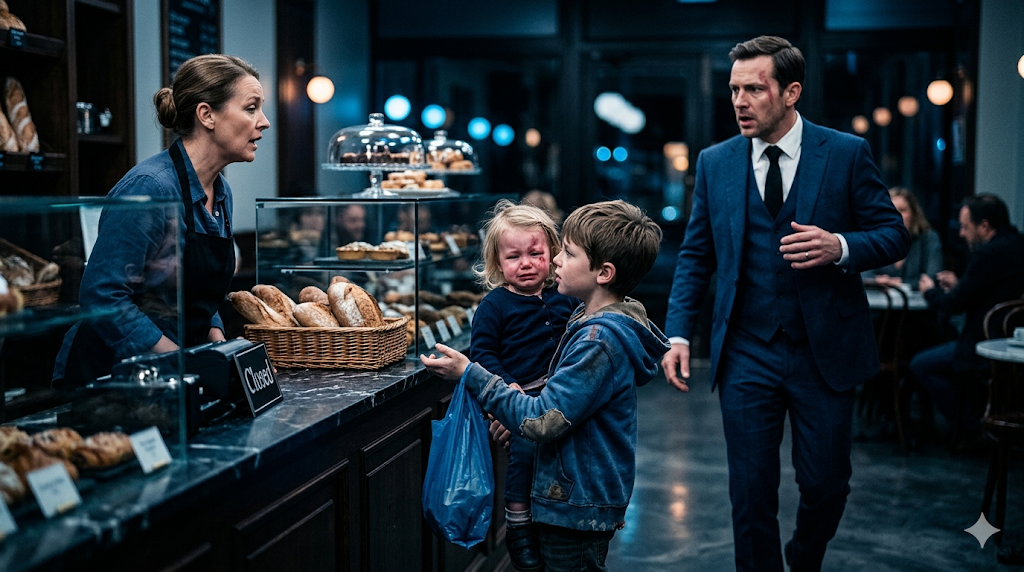
The Little Girl’s Birthmark Made a Wealthy Man Fall Apart in the Middle of a Café
The bakery smelled like butter, cinnamon, and warm bread — the kind of place where people paid twelve dollars for a coffee they’d photograph before drinking, and left pastries half-eaten on linen napkins like discarding small luxuries was something to feel comfortable about.
Everything was warm. Controlled. Comfortable.
Elias knew the moment he stepped inside that he didn’t belong here.
He was eight years old, wearing a gray hoodie two sizes too large — someone’s donation, probably, passed through a shelter bin and into his hands. Against his chest, he held his little sister the way someone carries something they’re terrified of dropping. Lily was two and a half, and she hadn’t stopped crying for the better part of an hour. Her small beige dress was wrinkled and stained at the hem — apple juice, maybe, or just the general grime of days without a proper wash. Her face was buried in his shoulder, voice wet and breaking.
“I’m hungry…”
Elias swallowed everything he felt. All of it. The embarrassment, the fear, the bone-deep exhaustion that had taken root in him sometime in late winter and never quite left. He swallowed it the way a child learns to — completely, quietly, without complaint — and walked toward the counter.
Slowly.
Carefully.
Like hope was something fragile. Like he already knew it was cracked.
The woman behind the register had blonde hair pinned back and a name tag that said SOPHIE in clean capitals. She was scrolling something on her phone when she heard footsteps and looked up. Her eyes moved over the boy. The crying toddler. The too-big hoodie. She put on the face that people put on in moments like this — not unkind exactly, but closed. Preemptively tired.
Elias looked up at her.
“Do you have any bread from yesterday,” he asked quietly, “that you sell for less?”
His voice was careful. Practiced. Like he’d rehearsed it — turned it over in his mind on the walk here, found the version that was least likely to get a no.
For one second — just one — Sophie’s expression softened.
Something moved behind her eyes.
Then it was gone.
“We don’t sell leftovers here.”
She didn’t say it cruelly. That was almost the harder part. She said it the way people say things they’ve already decided aren’t their problem — matter-of-fact, final, moving on.
Elias didn’t argue. Didn’t beg. Didn’t look angry. Those were responses that cost something he didn’t have left.
He just lowered his eyes.
He held Lily tighter as her crying grew worse.
At a table near the window, a man in a black suit had gone very still.
His name was Richard Harmon. He was sixty-one years old, recently retired from a finance career that had made him wealthy and, if he was honest with himself in the quieter moments — which he was not, most of the time — very alone. He had a driver. A penthouse. A routine that filled the shape of a life without quite becoming one. He’d come here, as he did most mornings, for a coffee and twenty minutes of silence before his day began.
He had been watching the boy since the door opened.
Something about the way the child walked — upright despite everything, deliberate, careful — had pulled Richard’s attention away from his phone.
And then he heard the boy’s voice.
And something in it — some note of dignity so intact it made the surrounding room feel smaller by comparison — had unsettled him in a way he hadn’t expected.
He heard Sophie’s answer.
He watched the boy lower his eyes.
And Richard Harmon — who prided himself on efficiency, on not becoming emotionally involved in things that were not his business — set his coffee cup down.
His chair scraped across the polished floor. Loud enough that heads turned. Conversations stopped mid-sentence. A woman at the far table looked up from her laptop. Two men at the counter paused in their order.
Richard walked to the register.
He didn’t hurry. He never hurried. It made people nervous in a way that hurrying never did.
“Pack everything,” he said.
Sophie blinked. “Sir?”
“Everything. What’s on display. What’s in the back. Everything.”
The café went still the way a room goes still when someone does something large and unexpected. Not chaos — just that collective held breath when ordinary patterns get interrupted.
Sophie turned, uncertain, and began gathering items from the display case. Croissants, pain au chocolat, a loaf of sourdough, small jars of jam, a cluster of danishes still warm from the morning bake.
But Richard wasn’t watching the food.
He turned and looked at the children.
At Lily first — because she was crying, and crying children have a way of demanding you look at them.
And then something strange happened inside his chest.
He stepped closer.
Not fast. Carefully. The way you approach something you don’t want to startle.
“Come with me,” he said gently.
Elias reacted the way children who have learned to be careful react. Half a step back. Arms drawing tighter around Lily. Eyes that had been tired a moment ago now sharp and watchful.
Not grateful. Careful.
“Why?” he asked.
Richard opened his mouth to answer.
But he’d stopped seeing the boy.
He was looking at Lily.
At her face.
First her eyes — dark, the shape of them familiar in a way he couldn’t immediately place. Then her mouth, the specific curve of the upper lip. And then — as she turned slightly in her brother’s arms, still crying, face tilting — he saw it.
A small crescent-shaped birthmark near her left temple.
The world tilted.
Richard had seen that birthmark before.
He had kissed it goodnight, once, on a tiny forehead. Twenty years ago. On his daughter. On Elena, four days old, asleep in her hospital bassinet, and he had pressed his lips to that small crescent and thought, with the unguarded tenderness of new fatherhood: I will never let anything hurt you.
He had not been good at keeping that promise.
His hand lifted — he didn’t intend it, it just rose, trembling, reaching toward the child’s face—
And stopped.
Just short of touching her.
Like he already knew something he wasn’t ready to confirm.
The boy noticed. Of course the boy noticed. He noticed everything.
“What?” Elias’s voice had sharpened. Protective.
Richard struggled to remember how to breathe properly.
“What’s her name?”
Elias looked at him the way a child looks at an adult when they’re deciding whether the adult can be trusted. Eyes going to the door. To Sophie. Back.
Then:
“Lily.”
The name detonated quietly in the center of Richard’s chest.
Years ago — seven years, maybe eight — his daughter Elena had been sitting at his dinner table, twenty-three years old, laughing at something her boyfriend had said. Richard hadn’t liked the boyfriend. Hadn’t liked anything about what Elena’s life was becoming: the small apartment, the arts degree, the man who worked with his hands and didn’t own a tie. Richard had been particular about the life he’d imagined for her. He’d made that known, repeatedly, with the confidence of a man who confused control with love.
And Elena had laughed that evening, some private joke with her boyfriend, and then turned to her father and said, brightly, completely unguarded: “If I ever have a girl, I’m going to name her Lily.”
Richard had said something dismissive.
He couldn’t even remember what.
“And your mother?” he asked now. His voice didn’t sound like his own.
The question changed the boy’s face.
Not suspicion this time. Something older. Something that had been carried quietly for months and didn’t get set down often.
He looked at Lily. Then back up.
“…She’s gone.”
The café had gone completely silent. Sophie had stopped moving. The woman with the laptop had closed the screen. Even the ambient music — something soft and acoustic that had been playing since Richard arrived — seemed to have dimmed.
“Gone how?” Richard asked.
Elias’s jaw tightened. He forced the words out the way you force something through a narrow space.
“She got sick. In the winter.”
Richard closed his eyes.
Just for a second.
When you close your eyes in a moment like that, it’s because you need somewhere to put something too large to hold in your face. He put it there, in the dark behind his eyelids, and felt it break.
Lily had gone quiet, finally. She was looking at Richard with the wide, unreadable curiosity of a toddler encountering something she didn’t have words for yet.
He looked at her.
Then at the boy.
And now — now that he was really looking — he saw what he’d missed beneath the exhaustion and the wariness and the too-big hoodie.
He saw Elena.
In the boy’s jaw. In the careful dignity of the way he held himself. In the way he looked at his sister the same way Elena used to look at things she was trying to protect.
And in Lily — in those eyes, that birthmark, that small mouth — he saw her even more clearly.
His daughter.
In both of them.
“What was your mother’s name?” he asked.
He knew.
He needed to hear it.
Elias studied him for a long moment. Something was shifting in the boy — the careful assessment of someone older than his years, deciding.
Then, very quietly:
“Elena.”
The sound of it nearly took Richard’s legs out from under him. He gripped the counter edge. Once. Let go.
His hands were shaking openly now. He didn’t try to hide it.
Elias watched his hands.
And something in the boy’s expression changed. Not trust — trust was not something you arrived at in five minutes with a stranger in an expensive suit. But something adjacent to it. A reading. A decision.
Slowly, he shifted Lily to one arm. Reached into the front pocket of his hoodie with his free hand. Carefully.
He pulled out an envelope.
It was old. Worn at the edges, soft from repeated handling. The paper had yellowed slightly at the corners. Someone had carried it close for a long time. Kept it from rain, from folding, from the general damage of hard months.
He held it out.
But he didn’t let go.
“Mom said—” his voice was very quiet now, “—if we ever got too hungry… and if a man looked at Lily like he recognized her…”
He paused.
“She said I should give him this.”
Richard looked at the envelope.
His name was not on it.
Just four words, in handwriting he recognized immediately — neat, slightly tilted to the right, the way Elena had always written since she was eleven years old:
For my father.
His fingers trembled as he took it.
He turned away slightly. Faced the window. The morning light through the glass was ordinary and indifferent and he was grateful for it.
He opened the envelope.
Inside was a single folded page. He opened it.
His eyes found the first line.
And everything inside him — every defense, every pride, every wall he’d spent decades building around himself because walls were easier than love and love was something that had hurt him too and he had never learned the difference between protecting yourself and exiling yourself — everything came down.
Because it said:
“Dad, if you’re reading this… hunger reached your grandchildren before your pride did.”
He read the rest standing there, by the window, in a café that had gone so quiet you could hear the street outside. Sophie had stopped pretending to be busy. The other patrons had stopped pretending not to watch.
Elena had written two pages.
She wrote that she hadn’t been angry — not at the end. That somewhere in the months when she was sick and the boy was learning to be a little father and Lily was learning to walk, she had let the anger go because she didn’t have the energy for it anymore and love was a more efficient fuel.
She wrote that she wanted him to know about Elias — about how he read picture books to Lily every night even when they were both hungry, about how he’d learned to check expiration dates and stretch a loaf of bread across three days, about how he cried only when he thought Lily was asleep.
She wrote: “He has your stubbornness and my heart. I don’t know which one is going to save him.”
She wrote that she wasn’t asking Richard to fix anything. That she understood him, finally, in the way you only understand people after you’ve failed at some of the same things. That she knew he had loved her in the language he’d been given, which was a limited language, but it was his.
She wrote: “Take care of them. Not because you owe me. Because you still have time to be different.”
She wrote: “I forgive you, Dad. I’ve been forgiving you for years. I just needed you to know that before you found out about them.”
She signed it: Elena.
Underneath: P.S. Lily already laughs like you. I thought you should know.
Richard folded the letter. Very carefully. Put it back in the envelope.
He stood at the window for a moment longer, composing himself as best he could, which was imperfectly and visibly and not at all the way he usually managed himself.
Then he turned.
Elias was watching him. Still holding Lily, who had discovered a button on his hoodie and was turning it over with focused concentration.
Richard looked at the boy.
At this eight-year-old who had carried his sister and an envelope across however many hard weeks, following the last instructions of a woman who had loved him better than Richard had loved her.
“Are you hungry?” Richard asked.
Elias looked at him for a long moment.
“Yes,” he said. Simply. No pride in it, no shame. Just a fact.
Richard nodded. He turned to Sophie.
“We’ll need a table,” he said. “And everything you have. Hot.”
Sophie was already moving.
Richard turned back to the children. He looked at Lily — at that crescent birthmark, so familiar it made his chest ache — and then at Elias.
“Sit with me?” he said.
It was not a command. He was careful about that. After everything, the least he could do was be careful about that.
Elias considered him with those dark, watchful, too-old eyes.
Then he shifted Lily on his hip, and walked — slowly, carefully, not fully trusting but moving anyway — toward a table by the window.
Richard followed.
Outside, the morning moved on indifferently. Buses passed. Pigeons argued over a crumb near the doorway. Somewhere down the street, a vendor was setting up a flower stand.
Inside, a grandfather sat across from his grandchildren for the first time.
Lily grabbed a croissant with both hands and said, with great authority: “Mine.”
Elias almost smiled. Almost — the kind of almost that’s been practiced out of a person, that needs time and safety and repetition to come back.
Richard noticed.
He filed it away.
Time, Elena had written. You still have time.
He poured a small glass of orange juice for Lily, who regarded it with the seriousness it deserved. He cut the sourdough into careful slices and put the basket between them. He didn’t speak. He didn’t have the right to fill the silence with anything yet. He had years of silence he’d created and he would wait, patiently, for as long as the boy needed.
Elias ate quietly. Steadily. The way someone eats when they’ve been hungry long enough to stop rushing food.
After a while, without looking up, he said:
“She talked about you sometimes.”
Richard waited.
“Not a lot,” Elias added. Clarifying. Making sure it wasn’t misunderstood. “But sometimes.”
“What did she say?” Richard asked.
A pause.
“That you were difficult.” A beat. “And that she loved you anyway.”
Richard looked at the table. At his coffee cup. At his hands — steady now, mostly.
“She was right,” he said. “On both counts.”
Elias looked at him then. Directly. Assessing.
Something passed between them — not warmth yet, not forgiveness, not the easy resolution of things. Just the beginning of a reckoning. The first moment of something that would take a long time and would not always be comfortable and would be, in the end, the most important work either of them had left to do.
Lily held her croissant out toward Richard with magnificent generosity.
“Bite?” she offered.
He looked at that small face. That crescent birthmark. His daughter’s nose.
“Yes,” he said. “Thank you.”
Lily nodded, very seriously, and the morning went on.