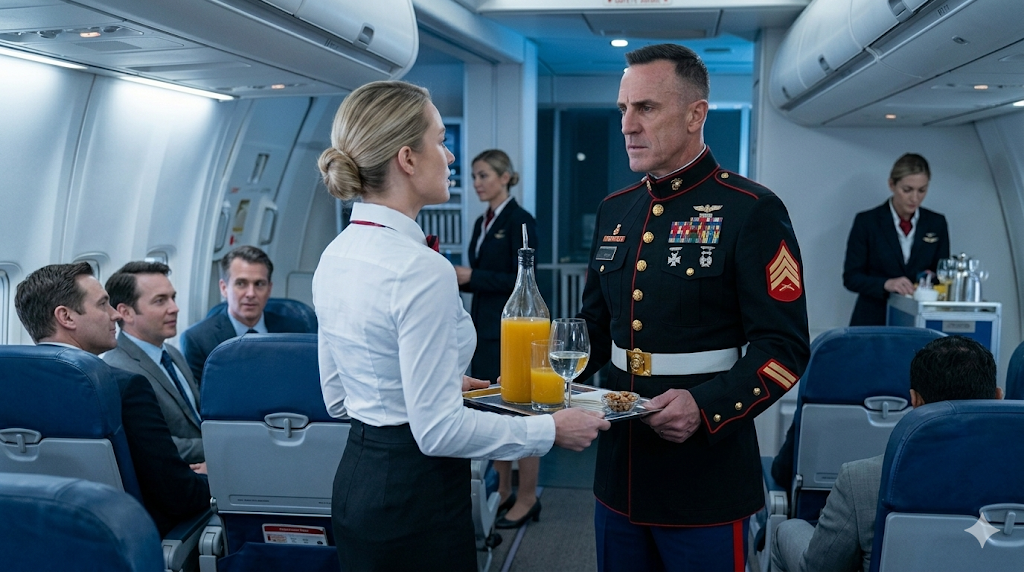
He Thought She Was Nobody. Her Past Had Other Plans
A decorated Marine in dress blues just slapped a waitress across the face in the middle of a five-star restaurant… What he didn’t know was who she used to be. Within seconds, all 200 pounds of him were sliding across the floor in a submission hold, gasping for air.
The Gilded Anchor was the kind of place where money didn’t talk — it whispered. Crystal chandeliers cast their amber warmth over white-clothed tables, where the city’s power brokers sealed deals over Wagyu and aged Bordeaux. The staff moved like shadows: efficient, invisible, forgettable.
Elena Vasquez had worked hard to be forgettable.
At thirty-four, she carried herself with the quiet discipline of someone who’d lived more than one life. Her dark hair was pinned back neatly, her black apron pressed smooth, and her eyes — dark, still, and deeply watchful — were the only feature that occasionally made customers uncomfortable, though they could never explain why. She’d been at The Gilded Anchor for two years. It was her sanctuary, in a way. Routine. Predictable. Safe.
She told herself she needed that.
It was a Thursday evening, the restaurant near capacity, when she picked up the heavy tray — eight crystal glasses filled with amber cocktails for the large corporate table by the window. She navigated the floor with practiced ease, weaving between chairs and guests, her balance flawless.
Then her heel snagged the edge of the ornamental rug near booth seven.
Time fractured into slow motion. She felt the tray tilt. Felt the physics of it become inevitable. She tried to correct — she almost did — but the glasses were already sliding, and a cascade of sticky orange juice, ice, and crystal shards rained down over the corner booth in a spectacular, catastrophic arc.
Directly onto the man sitting in it.
Colonel Harlan Pruett, United States Marine Corps — or at least, that’s what his business card said when he handed it to hostesses hoping for preferential seating — rose from the booth like a storm system. His Dress Blues were immaculate no longer. Orange juice darkened the midnight-blue of his jacket, and shards of crystal glittered in his lap. The chest full of ribbons — Air Medal, Meritorious Service, a Bronze Star — dripped with cocktail.
The restaurant went silent.
Elena was already opening her mouth, apology instinctive and genuine, when his hand moved.
It wasn’t a gesture. It wasn’t a reflex. It was deliberate and contemptuous — the swing of a man who had never once been told no, who had mistaken rank for ownership and power for permission. The crack of his palm across her cheek split the air like a starting pistol.
Her head snapped sideways. Her hair fell across her face.
A woman at the adjacent table gasped. A sommelier froze mid-pour. The murmur of sixty conversations collapsed into a single held breath.
Elena didn’t move for five seconds.
She stood perfectly still, hunched slightly, her hand rising slowly to her jaw. Those five seconds felt geological — ancient, heavy, like the world was waiting to find out what kind of woman she really was.
When she looked up, Colonel Pruett saw it. He would describe it later — to no one who believed him — as the most frightening thing he’d encountered in thirty years of service. Not fear in her eyes. Not tears. Something colder. Something that had been sleeping for two years and had just been woken up.
Recognition.
Elena’s body language changed in a way that was subtle and total. Her weight dropped fractionally lower. Her shoulders settled back and squared. Her hands, previously splayed in surprise, curled into compact, practiced fists. She was no longer a waitress who had tripped. She was something older, something trained, something that had operated in places where mistakes had body counts.
Colonel Pruett — whatever his genuine military service, whatever real valor might have once lived behind those ribbons — had spent too many years in boardrooms and banquets since then. He saw the shift in her and did the worst possible thing: he lunged.
It was clumsy and furious and telegraphed from three feet away.
Elena parried his grabbing hand with a sharp outward block — the thud of forearm on forearm cracked across the silent room. She used his own forward momentum, stepping slightly aside, and drove two short, devastating punches into his floating ribs with the mechanical precision of someone who had done this in darker rooms than this one. The air left him with a grunt.
He stumbled.
She didn’t wait. She pivoted, loaded her left hip, and delivered a high roundhouse kick that connected cleanly with the side of his jaw. The sound was something between a crack and a thud — the sound of a very large, very certain man suddenly being shown the limits of certainty. His knees buckled.
And still she moved. She stepped into his collapsing space, seized his sleeve and lapel, dropped her center of mass, and rotated her entire body in a single powerful movement. Colonel Pruett — two hundred and ten pounds of decorated, entitled authority — left the ground.
He came down hard, sliding several feet across the marble in the spilled juice he had struck a woman over, coming to rest under the horrified gaze of sixty diners who had paid four hundred dollars a head to have a quiet evening.
Elena was on him before the slide ended. One knee pressed into his sternum — precisely calibrated, enough to immobilize without breaking anything. His right arm was locked in a joint submission that she held with the casual authority of someone doing paperwork. His face was pressed sideways against the cold marble, staring at the legs of his own overturned booth.
The restaurant was perfectly, completely silent.
She leaned down. Her voice, when it came, was low — not loud, not theatrical. Quiet, the way that real conviction is always quiet.
“Never. Hit. A woman. Again.”
She held the lock for exactly two more seconds. Then she released him, stood, and smoothed her apron with both hands. She glanced once around the room — not in triumph, not seeking applause, but in the practiced way of someone assessing that a situation was truly concluded.
It was.
She picked up her tray from the floor where it had fallen, tucked it under her arm, and walked toward the kitchen at a pace that was entirely, absolutely normal.
The kitchen doors swung shut behind her.
Behind her, Colonel Pruett lay on the marble floor, trying to remember how to breathe, surrounded by the debris of shattered crystal and his own shattered certainty. The sommelier finally set down his bottle. A table near the back began, tentatively, to applaud. Then another. Then another.
By the time the manager reached the kitchen to ask Elena if she was alright, she had already re-pinned her hair, refreshed the tray, and was loading the next round of cocktails.
“I’m fine, Thomas,” she said, without looking up. “Table four is waiting.”
He stood in the doorway for a moment, looking at her — really looking at her, perhaps for the first time.
“Elena,” he said slowly. “Who are you?”
She glanced over her shoulder, and for just a moment, the ghost of something — a different uniform, a different world, a version of herself she’d buried and paid dearly to leave behind — crossed her face like weather over water.
“Someone who used to do a much harder job,” she said.
And she walked back out onto the floor.
Colonel Pruett was escorted out by building security seventeen minutes later, still insisting to anyone who would listen that he wanted to press charges. The two officers who responded knew her name. They laughed for a long time on the drive back.
Elena finished her shift. She declined all the free drinks offered by grateful diners. She declined the standing ovation from table twelve. She smiled at the elderly couple in booth three who called her “extraordinary,” and told them their crème brûlée would be out shortly.
When her shift ended, she took the long way home through the park, watching the city lights refract off the dark water, and felt — for the first time in two years — something she hadn’t expected to feel here, in this quiet reinvented life.
Herself.