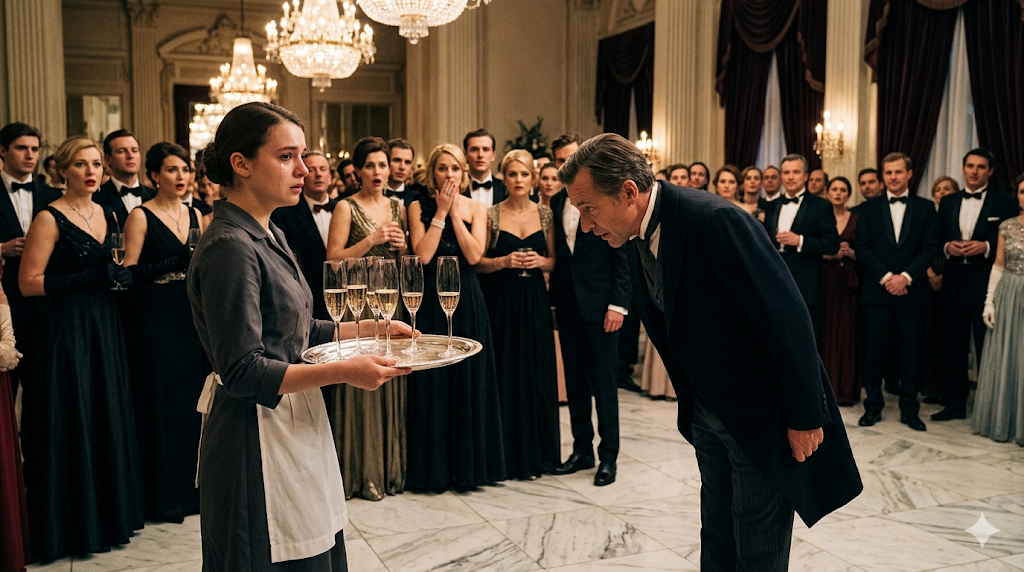
She Served Champagne to the People Who Were Supposed to Bow to Her
No one paid attention to the maid.
And in that glittering ballroom, that was exactly the point.
Her name was Elena. But no one here knew that. No one here knew anything about her — not the country she came from, not the blood in her veins, not the weight she carried beneath the stiff gray fabric of her uniform. To the guests of the Whitmore estate, she was invisible. A shadow with a tray. A ghost who refilled glasses and disappeared.
And that invisibility, as painful as it was, had saved her life.
The ballroom was obscene in its beauty. Crystal chandeliers dripped light like melting stars. The marble floor reflected the silk gowns and polished shoes that glided across it, making the guests look as if they were floating. The orchestra played something languid and expensive. Champagne flowed. Diamonds sparkled. Laughter rose and fell in practiced, musical waves — the kind of laughter that says: I have everything, and isn’t that wonderful for me?
Elena moved through the edges of the room, as she always did, holding her tray with both hands, her back straight, her eyes cast downward.
Invisible.
She had been invisible for three years.
Three years since she had crossed the border with nothing but a forged passport and the clothes on her back. Three years since she had left behind a palace, a title, a country on the edge of civil war — and a father who had chosen power over his own daughter. Three years of small rooms, cracked hands, aching feet, and the particular humiliation of being ignored in a hundred different languages.
But she had survived.
Because survival, Elena had learned, did not require dignity. It only required discipline.
A burst of laughter from her left made her instinctively slow her steps.
The man in the sharp black tuxedo — she had heard the other servants call him Mr. Hargrove — stood at the center of a small circle of admirers, one manicured hand wrapped around his champagne flute, the other resting on the arm of the woman beside him. His wife, or perhaps his companion for the evening — the line between the two, Elena had noticed, was rarely important to men like him.
He was the kind of man who owned things. Rooms. Conversations. People.
He reached over without looking — without breaking eye contact with his audience, without pausing his story — and plucked the last glass from Elena’s tray.
She was right there.
She was a foot away.
He did not see her.
“Beautiful evening, isn’t it?” he said, directing the words to the woman beside him, who tilted her chin upward and surveyed the room as if she were its rightful queen.
“Perfect,” the woman replied. “Nothing could ruin it.”
They laughed. The circle laughed.
And in the middle of it, Elena stood holding an empty tray, invisible, small, and furious in the only way she allowed herself to be — a fury locked so deep inside her chest that no one would ever see it unless she chose to show them.
She chose, as always, not to.
She turned away.
And that was when the doors opened.
The sound was wrong — too sudden, too hard, too disrespectful of the evening’s careful choreography. A pair of gilded doors at the far end of the ballroom swung inward with a force that made the nearest guests stumble backward in shock. The music lurched. Somewhere to Elena’s left, a champagne glass shattered.
Heads turned.
Voices died.
In the doorway stood a man.
He was dressed in black, but not the polished, performative black of everyone else in the room. His jacket was travel-worn, slightly creased, as if he had been moving fast and hadn’t had time to care. His face was pale — not the practiced pallor of aristocracy, but the pallor of someone who had been searching desperately and had finally, finally arrived.
His eyes swept the room.
They stopped.
They found her.
Elena felt something cold move through her.
She knew that face.
She had tried very hard to forget it.
Commander Aldric Voss. Head of the royal guard. Her father’s most trusted man — or he had been, once. Before everything fell apart. Before she ran.
He crossed the ballroom floor at a pace that stopped just short of a run.
The guests parted for him without knowing why — he had that quality, the kind of presence that made your body move out of the way before your mind had decided to. He passed between silk gowns and polished shoes and towering floral arrangements, his gaze fixed entirely on Elena.
Around her, she heard the whispers begin.
Why is he looking at the maid?
Is something wrong?
Who is he?
Elena did not move. She could not make herself move. She stood with her empty tray in both hands, her heart slamming against her ribs, and she watched Commander Voss walk toward her with the focused, unrelenting stride of a man who had crossed three borders and spent three years looking.
He stopped directly in front of her.
The entire ballroom was watching now. Even the orchestra had surrendered, the last note fading into total silence.
Voss looked at her.
Really looked at her — not the way the guests looked, past her, through her, as if she didn’t exist. He looked at her the way someone looks at the thing they have been searching for.
With relief.
With recognition.
With something that, in another life, might have been called grief.
“Sir…?” Elena whispered. Her voice was barely a thread.
Commander Voss bowed his head.
Not a polite, social inclination. Not the practiced half-bow of a man greeting an equal.
A deep, full bow. The kind reserved for one thing only.
The kind that had been shown to her since the day she was born, and which she had spent three years trying to forget.
“Your Highness,” he said.
Silence.
Complete, absolute, devastating silence.
Then — the gasp. One voice, then another, rippling outward through the room like a stone dropped into still water.
Elena’s fingers went cold around the tray.
Her chest felt hollow.
She had practiced this moment — not because she wanted it, but because she had been afraid of it. She had rehearsed what she would do if someone found her. She had planned to deny it. To laugh it off. To keep her eyes down and say, simply, I’m afraid you have the wrong person.
But when Commander Voss raised his head and looked at her with those exhausted, steadfast eyes, every planned word fell away.
“What did you say?” she breathed.
“Your Highness.” His voice did not waver. “Princess Elena. Heir to the Throne of Arestia. The king — your father — is dead.”
The room erupted.
Elena barely heard it.
She heard the word dead. She heard father. She heard the soft, specific sound of years collapsing.
“He — ” Her voice broke. “When?”
“Six days ago.” Voss reached into his jacket and produced a small, sealed envelope — the royal seal of Arestia pressed in deep red wax. Her family’s crest. A crest she had not seen in three years. “He signed it, Your Highness. Before the end. The succession documents. He named you. Not your brother. Not the council’s choice.” He paused. “You.”
Around them, the ballroom had dissolved into chaos.
The woman in white — Mr. Hargrove’s companion, the one who had said nothing could ruin the evening — had gone completely gray in the face. Hargrove himself was stiff as a column, the champagne glass still suspended in his frozen hand, as if his body hadn’t yet received the message that everything had changed.
Elena looked at the letter in Voss’s hands.
She looked at the seal.
She thought of three years of cold mornings and aching hands and champagne trays and eyes that looked through her as if she were furniture. She thought of her father. She thought of the last night she had seen him, when she had stood in his study while he told her, quietly, that her brother would inherit the throne, that she was “too inconvenient,” that it would be better for everyone if she simply disappeared.
She had.
And now he was dead.
And now he had changed his mind.
She looked up.
She met the eyes of the woman who had said nothing could ruin the evening.
She met the eyes of Mr. Hargrove, who had taken her glass without looking at her face.
She looked at every pair of eyes in that room — every startled, ashamed, disbelieving face staring back at her.
Her hand moved to the hidden clasp beneath her apron collar.
Her fingers found the small button there — the only piece of herself she had kept through three years of disappearance. Her mother’s locket, pressed flat against her collarbone. She had told herself it was a reminder. Now she understood it had been a proof.
She unclasped the apron.
She let it fall.
Beneath it, the plain gray dress. Beneath the plain gray dress, a woman who had survived things most people in this room could not imagine, and who had carried herself with more dignity while invisible than any of them had managed while being seen.
“Is the car outside?” she asked Voss.
“Yes, Your Highness.”
“The council?”
“Assembled and waiting.”
She nodded.
She set the empty tray down on the nearest table — calmly, deliberately, with the quiet precision of someone who has done their last task in a role they are leaving behind.
Then she looked at Commander Voss and said the first words she had ever spoken in this ballroom that anyone would remember.
“Let’s go home.”
She walked out of the ballroom.
Straight-backed.
Unhurried.
As the entire room watched in silence.
Mr. Hargrove set down his champagne glass slowly. It made a small sound against the silver tray. Around him, the guests stood frozen between their diamonds and their shame, caught between the instinct to bow and the paralysis of realizing they should have seen this coming.
One by one, they did bow.
Too late.
The doors closed behind her.
The orchestra, after a long pause, did not resume.
Because some silences, after certain exits, cannot simply be filled with music.
In the hallway outside, Commander Voss fell into step beside her.
“Are you all right, Your Highness?”
Elena considered the question.
She thought of the weight of the tray. The practiced lowering of her eyes. The laughter that had risen above her for three years. And she thought of the envelope in Voss’s hands — the seal of a country waiting for her, the throne of a man who had finally, in death, chosen her.
“No,” she said honestly.
Then, after a moment —
“But I will be.”
Outside, the black car waited, its engine running.
She got in.
And somewhere behind her, in a glittering ballroom full of champagne and chandeliers and the very particular shame of the powerful, the maid they had ignored was already a ghost.
But Princess Elena had just begun.