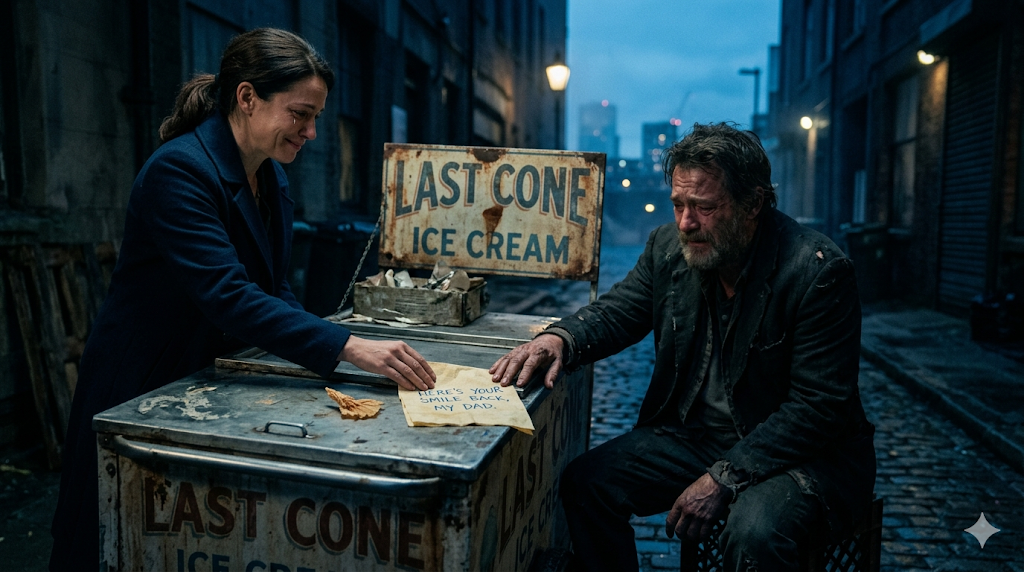
The Ice Cream Man Skipped Dinner So a Poor Girl Could Smile
Chapter 1: The Poorest Man’s Sweetest Lie
People always say that money washes away the stench of poverty.
They are dead wrong.
Even now, sitting in a glass-encased office on the 40th floor, draped in a designer suit that cost more than most people’s monthly rent, I can still smell the scorched asphalt of that July afternoon. I can still feel the heat rising from the pavement through the thin soles of shoes so worn they were basically cardboard wrapped in wishful thinking. Some sensory memories don’t fade with time. They just wait — patient and precise — for a moment of stillness in which to remind you where you came from.
When I was ten years old, hunger wasn’t merely a physical feeling. It was a living thing. A vicious, clawed monster that nested somewhere between my ribs and my stomach, tearing quietly, methodically, as if it had all the time in the world to destroy me. It accompanied me to school. It sat beside me in class. It followed me home every evening through streets that smelled of exhaust and frying oil — smells that were both torment and comfort, because at least they were proof the world still ate, even when I didn’t.
That particular July afternoon, I had been walking for nearly two hours. Not walking anywhere. Just walking — the way children who are not wanted at home will sometimes walk without destination, as if movement itself is a form of escape. The sun was not kind. It pressed down on the back of my neck like a hand that had decided to punish me personally.
And then I saw it.
A cart — modest, slightly dented, its painted lettering faded to near-illegibility — parked at the corner of Crane Street and the old market road. Behind it stood a man I had never seen before. He was perhaps sixty, with hair the color of ash and a frayed canvas apron that had once been blue. He moved with the unhurried deliberateness of someone who had long since made peace with a life that had not been particularly generous to him.
My feet stopped before my mind gave the instruction.
The ice cream in the metal containers gleamed under the July sun. Pale vanilla. Pistachio the color of new leaves. Something deep and dark that might have been chocolate. Each scoop looked cold enough to make the air around it tremble.
I stood at a distance. My clothes were smeared with the kind of grime that only comes from a life without enough hot water. My shoes had split at the right toe two weeks earlier and I had folded a piece of cardboard inside to keep the pavement from touching my foot directly. My hair — well. My hair was the least of anyone’s concerns, including mine.
I didn’t approach the cart. Children raised at the very bottom of the social order learn early that approaching things they cannot afford only leads to embarrassment, and embarrassment, in my experience, always seemed to hurt more than the hunger itself.
So I simply stood. And I looked.
My hand, with a will entirely its own, lifted slightly from my side — reaching, half-consciously, toward something that wasn’t there for me. I caught myself. The hand dropped.
But he had seen it.
The man — Mr. Thomas, though I didn’t know his name yet — was watching me with an expression I didn’t quite know how to catalogue. It wasn’t pity, exactly. It wasn’t the performative sympathy that adults sometimes aim at poor children like a beam of light they want credit for producing. It was something quieter and more serious. It was the look of a person who recognized something. Perhaps himself, at a younger age. Perhaps simply a child who was hungry, in a world that too often considers hunger a private failing.
He reached into the metal container without ceremony.
He didn’t ask if I wanted one. He didn’t make a production of the gesture. He simply scooped — generously, almost defiantly generously — a cone so tall and impossible that it seemed to defy physics, stacked three scoops high in a way that suggested he was building something, not just serving something.
He held it out across the counter.
“Take it, little one,” he said. His voice was low and unhurried, the way rivers sound when they are very wide. “It’s a gift.”
I stared at the cone, then at him.
“I…” My voice came out smaller than I intended. “I don’t have any money. Not even a little.”
“I know,” he said simply. And smiled.
That smile. I have spent fifteen years trying to describe it to people and always failing. It was not a smile of self-congratulation. It was not a smile that wanted anything in return. It was the smile of a person who had decided, in that particular moment, that the world could be made briefly better by an act so small it would go unrecorded by everyone except the two people involved.
I took the cone.
The cold hit my palm like a small miracle. I ate it slowly, not because I had the self-control to savor it, but because I was afraid of it ending. Pistachio. It was pistachio and something floral I couldn’t name, and it was the finest thing I had ever tasted in my ten years on earth, not because of the ice cream itself but because of the way it was given.
Before I left, I turned back to him.
“One day,” I said, with a certainty I had no rational basis for, “I’ll pay you back. I promise.”
He let out a soft, low laugh. Not unkind. The laugh of a person who has heard promises before and learned to hold them gently, without expectation.
Because adults, in my experience, do not believe in promises made by hungry children on summer afternoons. The world teaches them not to.
He didn’t know — and neither did I, not then — what that afternoon had actually cost him.
Chapter 2: What the Ledger Didn’t Show
I learned the truth three years later, by accident, from the woman who ran the dry goods stall two streets over from where his cart used to stand. She mentioned it in passing, the way people mention things they assume are already known.
“Mr. Thomas?” she said. “Oh, that man was always giving things away. Used to say, ‘What’s the point of the last coin if you can’t spend it on something worth spending it on?’ That summer — oh, must’ve been seven, eight years back now — he gave away his last stock and walked home with nothing. Had to borrow bread from his neighbor for three days before his next delivery came in.”
I was thirteen when I heard this. Old enough to understand what it meant. Not just that he had given me ice cream. That he had given me his last inventory. That the profit he needed to buy his own dinner that evening had been handed, quite literally, to a girl he didn’t know and would never see again.
He had gone hungry so I wouldn’t have to.
The information landed in me and stayed there, lodged somewhere below language, below the place where ordinary memories live. It became the thing I returned to when the road ahead looked impossible. In the years that followed — and there were years, many years, that looked very much like impossibility — I would sometimes call up the memory of that cone, that smile, those words: Take it, little one. It’s a gift.
And I would keep going.
Chapter 3: Glass Floors
I won’t romanticize the years between Crane Street and the 40th floor. They were not romantic. They were a sequence of early mornings and late nights and decisions made in the narrow space between desperation and determination. They were scholarships fought for with the ferocity of someone who understood that education was the only ladder whose rungs nobody could take from you. They were jobs that paid little and demanded everything, and a graduate degree completed while working two of them simultaneously. They were meals skipped and winters endured in apartments where the heating was theoretical and the drafts were not.
But they led somewhere.
By thirty-two, I ran a mid-sized logistics firm with contracts in six countries. By thirty-four, we had expanded into three more. The office on the 40th floor was not something I had aimed at, precisely. It was simply where the work eventually deposited me, the way a river deposits sediment — slowly, without drama, at the point where the current finally slows.
I had staff now. And a private investigator on retainer for what my assistant called, diplomatically, “personal projects.”
The most personal of all had been running for three years.
“Find him,” I had told the investigator at the outset. “A man named Thomas. Ice cream vendor. Used to work the corner of Crane Street and the old market road, sometime in the mid-2000s. He’d be in his mid-to-late seventies now. That’s everything I have.”
“That’s almost nothing,” the investigator said.
“I know,” I said. “Find him anyway.”
Chapter 4: The Phone Call
I was in the middle of a call with our Singapore partner — something about customs clearance, something that required concentration — when my other phone buzzed on the desk.
The investigator’s name on the screen.
I held up a finger to my assistant, mouthed “one moment,” and stepped to the window.
“Tell me,” I said, before he could speak.
“I found him, ma’am.” A pause. The kind that carries weight. “But you need to move fast. There’s a situation.”
The Singapore call ceased to exist.
“What kind of situation?”
“He went bankrupt. About eight months ago — the chain stores finally wiped out his last regular route. He tried a few other things, couldn’t make them work. He’s been getting by on almost nothing.” Another pause. “The landlord who lets him store the cart wants the space back. There are also some men — I think connected to a loan he took out to try to keep the business going — who’ve been around. Today, from what my contact says, they’re planning to take the cart.”
I was already walking toward the coat rack.
“I’m coming,” I said. “Today. Right now.”
“It’s across the city in traffic—”
“Find me the fastest route and text it.”
I was in the elevator before he finished the sentence.
Chapter 5: Heels on Stone
The car stopped two buildings down because the street was too narrow to proceed. I stepped out without waiting for the driver to come around, and I walked — quickly, with the particular precision of someone who is trying not to run — through the mid-afternoon crowd.
I heard the raised voices before I saw them.
Two men, younger, louder, gesturing at the cart. And behind the cart — seated on an overturned crate, quite still, with the practiced stillness of someone who has run out of the energy required for alarm — was an old man with ash-colored hair and an apron that had once been blue.
He looked up as I approached. His eyes moved from my shoes to my suit to my face, with the expression of someone who cannot make sense of what they’re seeing.
The two men paused.
“Can I help you?” the larger of them said, in a tone that meant the opposite.
“No,” I said. “But you can leave.”
A brief silence. The kind that happens when two people try to calculate whether the well-dressed woman arriving by private car in the middle of their collection visit represents a complication they hadn’t budgeted for.
They left.
I turned to the old man.
He was attempting to stand — the automatic, slightly embarrassed reflex of someone confronted with unexpected formality.
“Please,” I said. “Don’t.”
I moved to the counter.
From my coat pocket, I removed the thing I had carried for twelve years.
A napkin. White once, ivory now, its edges browned and soft with age. I had kept it folded precisely, in the inner pocket of every coat I had owned since the dry goods woman told me the truth about that afternoon. I had found the napkin in a box of things from my childhood, recognizing it immediately — I had tucked it in my pocket that day after eating the ice cream, not knowing why, only knowing I wanted to keep something from the moment.
Inside the fold: a single dried flake of something sweet, probably sugar, probably from the cone. And written in the shaky, earnest handwriting of a ten-year-old: One day I’ll pay you back.
I placed it on the counter between us.
He looked at it. He picked it up. He unfolded it with the careful slowness of someone who understands that a thing has been well-kept and deserves to be treated accordingly.
His hands, when he read the words, began to tremble.
He looked up at me. His face had gone very pale.
“Do you remember,” I said, “the little girl who couldn’t afford ice cream?”
The silence that followed was the longest silence of my adult life.
“I remember,” he said finally. His voice was barely audible. “I remember a girl on a hot day.”
“You gave her your last cone,” I said. “The last one you had.”
His throat moved.
“And then you closed early,” I continued, “because you had no money left to buy dinner for yourself.”
He stared at me.
The afternoon light came through the gap between the buildings at a low angle that turned everything slightly gold — the cart, the counter, the napkin between us, the old man’s hands still holding it. I was aware, in a way that felt almost physical, of the distance between that July corner and this one, of the fifteen years that had passed like water, carrying me from one side of the city’s invisible wall to the other.
He didn’t speak. He didn’t need to.
“I told you I’d pay you back,” I said.
Chapter 6: What Repayment Looks Like
I had prepared for this, carefully, over three years of anticipation.
A commercial-grade refrigerated unit. A proper storefront — a small one, on a pedestrian street in a neighborhood that still had foot traffic, with a lease paid three years in advance. Staff, if he wanted them. A salary drawn from a fund I had set aside specifically for this purpose, indexed to adjust with inflation, for as long as he lived.
I told him all of this in simple language, without preamble, because I had learned that when you offer someone something they badly need, the worst thing you can do is make them sit through an elaborate emotional performance first. Dignity is better served by efficiency.
He listened without interrupting.
When I finished, he was quiet for a long time.
“I gave you one ice cream,” he said finally.
“You gave me considerably more than that,” I said.
He looked at the napkin again. At the child’s handwriting. At the dried sugar flake, impossibly preserved, a small artifact of an afternoon that had changed the direction of everything.
“I don’t need all of this,” he said.
“I know,” I said. “But I need to give it.”
He was quiet again.
Then, for the first time since I had arrived, he smiled. And it was — precisely, identically, impossibly — the same smile as the one on Crane Street fifteen years ago. The one that didn’t want anything in return. The one that had simply decided the world could be briefly better.
“You’ve done well,” he said softly.
“I had a good example,” I said.
We sat together beside the cart as the afternoon light shifted and the street filled with its early evening noise — vendors, children, the smell of something frying somewhere nearby. I bought two cones from the remaining stock in the cart. Pistachio. He raised an eyebrow when I specified the flavor, and I said nothing, and something passed between us that didn’t require words.
We ate slowly.
The world, for that particular hour, was exactly the right size.
Epilogue
The storefront opened four months later. He named it himself: Corner Cone. A reference, he explained to the neighborhood paper that came to do a small feature, to where he’d spent most of his working life — the corners of things, the edges, the parts of the city that nobody photographs.
I visited whenever I was in that part of the city, which became more often than strictly necessary.
He never asked why I kept coming back.
I think he knew.
Some debts are not repaid in money. They are repaid in the decision to become someone worthy of the gift. He had handed me, on a hot July afternoon, more than ice cream. He had handed me proof that kindness was not a resource that depleted. That a person with nothing could still give something. That the smallest gestures are sometimes the ones that change the entire shape of a life.
I carry that proof still.
I always will.