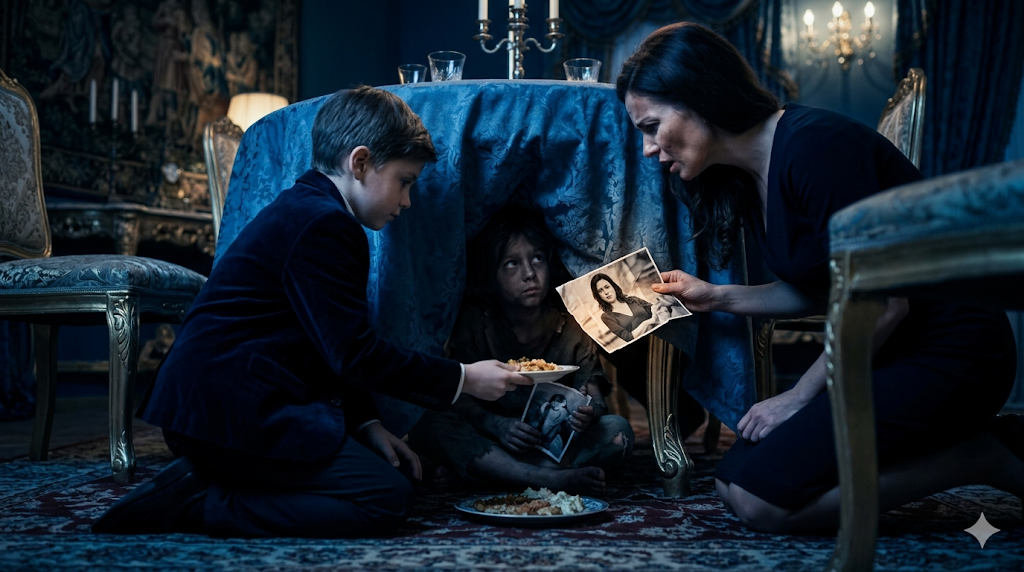
Her Son Secretly Fed a Starving Boy at Dinner
The Restaurant
The reservation had been made three weeks in advance.
Victoria Langford did not leave things to chance — not her schedule, not her appearance, not the table she occupied at Cérise, the most quietly expensive restaurant in the city. Corner booth. White tablecloth ironed sharp as a blade. A single orchid in a crystal vase. The kind of table that said: we belong here without saying anything at all.
She had brought her son, Elliot, to celebrate. His acceptance letter to the Kensington Academy had arrived that morning, sealed in cream-colored paper with an embossed crest. She had photographed it before he even read it. Posted it to three different places. The comments had flooded in. Congratulations, Victoria. You must be so proud.
She was.
Elliot was eleven years old, neat-haired, and dressed in the black jacket and pressed trousers she had laid out for him. He sat across from her with perfect posture — she’d reminded him twice in the car — and studied the menu with the mild interest of a boy who had learned early that enthusiasm was something you moderated.
“The duck,” Victoria said without looking up. “Or the sea bass. Not the pasta.”
“Yes, Mom.”
“Sit up straighter.”
“I am sitting straight.”
She glanced at him over the top of her menu. He was, in fact, sitting perfectly straight. She looked away.
The restaurant was full in the way that only Wednesday evenings could produce: a soft hum of conversation, the occasional laugh kept tastefully low, a pianist near the window cycling through something classical that no one was really listening to. Victoria lifted her water glass and studied the other tables with the automatic surveillance of a woman who had long ago decided that watching people was its own kind of power.
She did not notice the boy under the table.
Not at first.
It was the movement that caught her — a slight shift in the tablecloth near Elliot’s feet, a small disruption in the perfect geometry of the room. She frowned without knowing why. Then she saw Elliot’s hand drop beneath the table. Then she heard the faintest sound — not quite rustling, not quite breathing. Something small and careful.
She set her glass down.
“Elliot.”
He looked up. His expression didn’t change, but something behind his eyes did. Something adjusted. He knew she’d seen.
Victoria pushed back her chair and leaned slightly forward, and there he was.
A boy.
No older than eight, crouched in the narrow space between Elliot’s feet and the base of the table, half-hidden by the fall of white linen. He wore a grey hoodie that had once been darker and hadn’t been washed in a long time. His jeans were too short. His shoes were the kind that had been bought two sizes too big to grow into and had instead worn down at the toes before the growing could happen. His hands — thin, nicked, with dirt still caught under the nails despite what must have been some effort to clean them — were wrapped around a bread roll and two wedges of roasted potato that had clearly just been handed to him from Elliot’s plate.
He was eating. Quietly. Carefully. As if silence was the price of staying.
When he looked up and saw Victoria’s face, he stopped.
The restaurant did too. Not all at once, but in waves — a fork lowered here, a conversation paused there. The pianist played two more bars and then, as if even the music understood the shift in air pressure, drifted to silence.
“What are you doing under our table?” Victoria said.
Her voice was not loud. It didn’t need to be.
The boy said nothing. He gripped the bread roll tighter.
Elliot said, very quietly: “He was hungry, Mom.”
Victoria stood up fully. She was a tall woman, and in heels she was taller. She looked at the boy the way she looked at things that needed to be corrected — quickly, completely.
“Get away from my son,” she said.
The boy flinched. A full-body thing, small and involuntary, like something in him had been waiting for exactly those words and had braced for them anyway.
But Elliot didn’t flinch. He sat very still in his chair and looked at his mother with the measured calm of a boy who had learned to choose his moments carefully.
“He was hungry,” Elliot said again. “I had food I wasn’t going to eat.”
“That is not the point.”
“Then what’s the point?”
Victoria turned to him with an expression that said: not here, not now, not like this. Elliot looked back at her with an expression that said something she hadn’t seen on his face before, something older than eleven years old, something that made her stomach shift in a way she couldn’t immediately name.
She looked back at the homeless boy.
“This is a private restaurant,” she said. “You can’t be here. I’m going to have someone take you outside, and then you need to go home. Do you understand?”
The boy looked up at her.
His eyes were dark brown. His face was thin, the cheeks slightly hollow the way faces got when they had missed too many meals over too long a time. He was dirty. He smelled faintly of cold air and pavement and something else — something faint and particular, something Victoria Langford had not thought about in ten years.
He said: “My mom said you would say that.”
The room was very quiet.
Victoria’s hand — which had been reaching toward the edge of the table to signal for the maître d’ — stopped.
“What did you say?”
The boy looked at her steadily. There was no aggression in his face, no defiance. Just that same quiet, braced steadiness. The steadiness of a child who had been sent somewhere difficult and had promised himself he would not run.
He reached into the front pocket of his hoodie.
He pulled out a photograph.
It was the size of a postcard, printed on paper that had been folded and unfolded many times. The edges were soft. One corner had been torn and then kept anyway. He held it out toward her, and his hand was not entirely steady, but he held it out.
Victoria took it.
She looked at it.
And the thing that happened to her face in the next four seconds was something that the other diners — the ones who were watching, and nearly all of them were watching — would describe differently depending on who they were. Some would say she went pale. Some would say she seemed to stop breathing. One woman, two tables over, would later tell her husband that it was like watching someone remember something they had been trying to forget.
In the photograph:
A baby. Maybe three months old. Wrapped in a yellow blanket that had once been Victoria’s favorite color. The baby was asleep, mouth slightly open, one fist against its cheek.
Beside the baby, a young woman. Late teens, or maybe twenty, maybe twenty-one. Dark hair. Thin face. A smile that was trying very hard to be more certain than it felt. She was sitting on the steps of what appeared to be a hospital. She was wearing a paper bracelet around her wrist — the kind they gave you when you were admitted.
And behind both of them, slightly blurred but unmistakable, visible through a window in the background — a little boy.
A little boy with neat hair and a new jacket and a face Victoria had been looking at across dinner tables for eleven years.
Elliot.
Victoria’s fingers tightened on the photograph.
Her mind worked fast. She was a woman who processed quickly, who had trained herself to stay ahead of information. But this — this — arrived too fast from too many directions at once, and for the first time in a very long time she felt herself losing the shape of a room she was supposed to control.
She looked at the boy on the floor.
“Who is your mother?” she said. Her voice was different now. Not sharp. Not authoritative. Something more fragile underneath it, something she couldn’t fully suppress.
“Her name is Mara,” the boy said.
The name hit Victoria like a closed fist.
Mara Holt.
Twenty-two years old. Nineteen years ago, when Victoria was twenty-three and newly married and desperate in a way she had never admitted to anyone. A hospital in the northeast quarter of the city. A social worker’s office. Forms signed in ink that dried before Victoria had fully decided. A baby — a girl, she had been told, placed with a family — and then a door closed, and then ten years of not allowing herself to think about what was behind it.
She had told herself it was the right thing. She had told herself she had been too young, too poor, too alone. She had told herself that the child would have a better life with someone who was ready.
She had never let herself follow that thought to its conclusion.
“Where is she?” Victoria said.
The boy said: “She’s outside.”
“Outside where?”
“She was waiting. In case you — in case you didn’t want to see her.” He paused. “She said probably you wouldn’t.”
Victoria stared at him. The photograph was still in her hand. The baby in the yellow blanket. The young woman trying to smile.
“She’s your mother,” Victoria said slowly. Working through it. “And you’re—”
“Her son,” he said. “Marcus. I’m eight.”
Victoria sat down. Not gracefully. The way people sat when their legs decided before their mind did.
Elliot was watching her. He hadn’t moved, hadn’t said anything. But his eyes were moving between the photograph and his mother’s face, and something was assembling itself behind them — the slow architecture of understanding.
“Mom,” he said carefully. “What’s going on?”
Victoria didn’t answer him. She looked at Marcus — at this thin, brave, hungry child who had crawled under a restaurant table and eaten bread in silence and waited — and she said, very quietly:
“How did you find me?”
“She’s been looking for a while,” Marcus said. “She found your name on a list. A hospital list. She said there was a program, a long time ago, for — ” He paused, searching for the word. “For reunification. She applied. But you never answered.”
Victoria closed her eyes.
She had received a letter. Fourteen months ago. From a social services office, through her lawyer. A request for contact from a biological child placed for adoption in the year — she had given it to her lawyer and said: handle this. She had never asked what that meant. She had assumed it meant no. She had told herself it was easier.
“She didn’t come in?” Victoria said.
“She said she wasn’t allowed. You have to have a reservation.” A pause. “And she doesn’t — she doesn’t have — ” He stopped himself. “She’s been standing outside. She said I should come in and try. She gave me the photograph.”
“She sent you in alone.”
“I volunteered,” Marcus said quickly, and the fierceness of it — the pride of it — almost undid her completely. “She didn’t want me to. But I said I would.”
Elliot looked at his mother and then at Marcus and then back at his mother.
“Is he family?” he said.
The word landed in the room like something dropped from a great height.
Victoria looked at her son — her son she had raised and loved and shaped into something she was proud of, her son who had just quietly slipped his dinner under a table to a hungry stranger because that was, apparently, who he was — and she felt the full weight of everything she had arranged her life to avoid feeling.
She stood up.
“Come with me,” she said to Marcus.
He scrambled to his feet, the bread roll still clutched in one hand. She looked at it for a moment — the careful grip, the instinctive holding-on — and something in her chest tore quietly, the way old fabric tears, without drama, along a line that was always weak.
“Bring it,” she said. “You don’t have to put it down.”
She walked to the entrance of the restaurant. The maître d’ stepped forward and she stopped him with a look and pushed through the door.
Outside, the evening air was cold. The street was lit in amber and the city moved around them, indifferent. On the steps beside a planter, sitting very still with her arms around herself, was a woman.
Not old. Not young. Mid-thirties, perhaps, in a coat that was clean but thin, with dark hair pulled back and a face that had Victoria’s own cheekbones — her actual cheekbones, the ones she saw in the mirror — and eyes that were large and dark and terrified in a way that she was trying desperately not to show.
She looked up when the door opened.
She stood up slowly, like someone who had rehearsed this moment a thousand times and was now discovering that the rehearsal hadn’t prepared them for the sound of it.
They looked at each other for a long moment.
Behind Victoria, the door opened again. Elliot stepped out. He looked at the woman. He looked at his mother’s face. He looked at Marcus, still holding the bread roll.
“Hi,” Elliot said to Marcus.
“Hi,” Marcus said.
“Are you still hungry? They have more inside.”
Marcus looked at his mother. Mara looked at Victoria. Victoria looked at Mara. The city went on around them, unaware.
“Yes,” Marcus said finally. “Yeah, I’m still hungry.”
Elliot held the door open.
And Victoria Langford — who had not cried in eleven years, who had arranged her life into clean lines and firm edges and controlled outcomes, who had once signed a form in drying ink and never looked back — stepped forward and said, in a voice she barely recognized:
“Come in. Both of you.”
Nobody moved for a moment.
Then Mara stepped forward.
And they went inside.
The maître d’ found them a larger table. It wasn’t a corner booth. It wasn’t perfect. There was no orchid in a crystal vase. But there were four chairs, and four glasses of water, and a basket of bread in the center that nobody needed to eat from the floor.
Elliot talked the whole time. He had a quality Victoria had never quite understood — an ability to fill silence with warmth, to make people feel that being there was the most natural thing. He asked Marcus about school, about what he liked, about whether he’d seen any good movies lately. Marcus answered in half-sentences at first, then full ones, then with something approaching animation.
Victoria and Mara spoke less. Some things were too large for dinner table conversation and had to wait. But they spoke. Carefully at first, and then with more courage than either of them had expected to find.
At the end of the evening, when the bill came, Mara began to reach for her coat pocket — a gesture so reflexive it clearly came from somewhere deep and proud — and Victoria stopped her with a slight shake of her head.
“Please,” Victoria said.
It was the smallest word. But Mara heard everything behind it.
Marcus fell asleep in the cab on the way to the shelter where they were staying, his head against his mother’s arm. Victoria wrote down her number on the back of a receipt. Mara took it and looked at it for a long moment and folded it and put it in her coat pocket.
“He found you,” Mara said. “I almost didn’t let him try.”
“I know,” Victoria said.
“I didn’t think you’d — ” She stopped.
“I know,” Victoria said again.
The cab stopped. Mara lifted Marcus carefully. He stirred but didn’t wake.
“Thank you,” she said.
Victoria nodded. She didn’t trust her voice.
She watched them go up the steps and through the door. Then she sat in the back of the cab in the dark and looked at her hands for a long time.
Her phone buzzed. Elliot, from the front seat.
A text: Are you okay?
She typed back: Yes.
Then she deleted it and typed: I don’t know yet.
Then she deleted that too and typed: Getting there.
She sent that one.
The cab pulled away from the curb. Somewhere behind them, a boy slept against his mother’s arm with his hands finally unclenched, holding nothing, needing to hold nothing.
And in a restaurant that was closing for the night, a waiter clearing a table in the corner found a bread roll left behind — still in its napkin, slightly crushed at one end from being gripped too tightly.
He threw it away without thinking.
He had no way of knowing what it had meant.
The End.