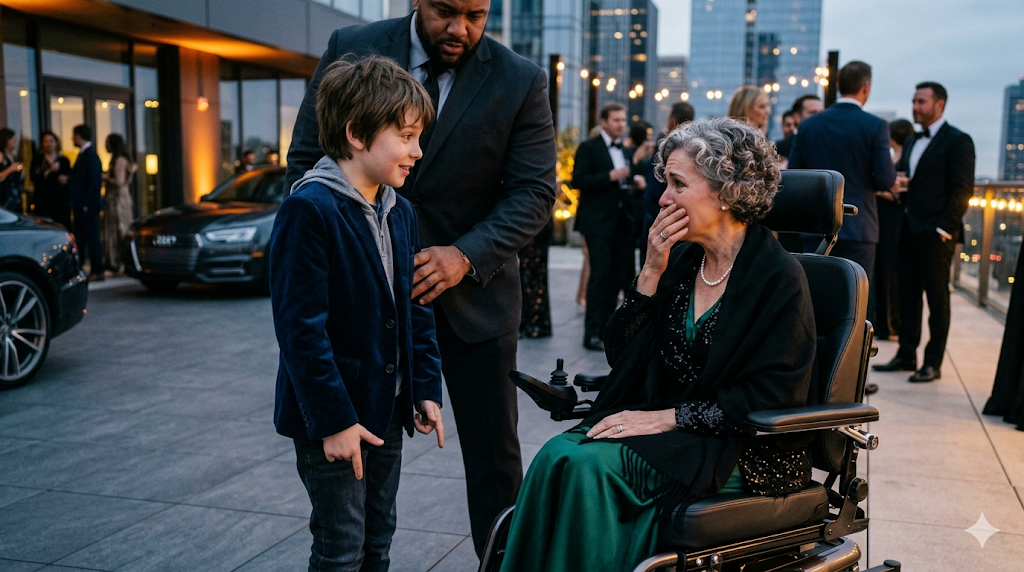
A Poor Boy Walked Into a Room Full of Millionaires. He Only Came to Find His Mother
The night of the Harrington Foundation gala had been planned for eight months.
Elena Harrington had not left her penthouse in three days before it. Her assistant, Clara, had laid out the gold-and-ivory gown on the velvet chaise the morning prior. The pearl earrings her mother gave her sat in their box on the vanity, still closed. Elena had stared at them for a long time that morning — at the way they caught the light, the way they reminded her of things she had tried very hard to stop thinking about.
She put them on anyway.
The rooftop of Harrington Tower had been transformed. Strings of warm Edison bulbs stretched in canopies overhead, and the city hummed forty-seven floors below — distant, small, manageable from up here. Canapés circled the room on silver trays. A quartet played something soft and French near the bar. Laughter arrived in waves, punctuated by the clink of crystal.
Elena’s wheelchair moved slowly through the crowd. She had grown accustomed to this — the way people slightly widened their stance when she approached, the quick shift of eyes that pretended not to notice the chair. She had learned to smile through all of it. She had learned to smile through many things.
“You look extraordinary tonight,” said Senator Voss, appearing at her elbow with his wife.
“Thank you, Charles.” She smiled. It was the practiced smile — warm enough to be gracious, measured enough to offer nothing.
Her head of security, Damien Park, kept a half-step behind her, as always. Six-foot-two, expressionless, expensive suit. He had worked for Elena for nine years and knew her silences better than most people knew her words.
It was Damien who saw the boy first.
He appeared at the rooftop entrance — the service entrance, because the main elevator required a key card — and for a moment he simply stood there, blinking at the lights and the people and the city beyond. He was perhaps seven or eight years old. Small for his age, wearing a collared shirt that had been carefully ironed but was slightly too large at the shoulders, like it had belonged to someone else first. His shoes were clean but old. His hair was combed flat with water that had already dried unevenly.
He did not look frightened. He looked like someone who had made a decision.
“Hey — ” A server noticed him first, stepping toward the boy with raised brows. “How did you get up here?”
“I took the stairs,” the boy said.
“Kid, this is a private event, you can’t—”
But the boy was no longer looking at the server. His eyes had moved across the room and found Elena with an precision that was almost unsettling — as though he’d been shown a photograph. As though he’d memorized the photograph.
He started walking toward her.
Damien saw it the same moment Elena did. She felt it before she understood it — some old, animal thing shifting in her chest, a feeling like standing at the edge of something.
“Ma’am,” Damien said quietly.
“I see him.”
The boy moved through the crowd. Guests stepped aside with surprised looks, some amused, some annoyed. A woman in a red dress made a noise of objection. The boy did not stop.
He stopped in front of Elena’s wheelchair.
Up close, he was even smaller than she’d thought. His eyes were dark — almost black in this light. His face had the particular seriousness of a child who has been carrying something heavy for a long time.
He looked down at her ankle.
Not at her face. At her ankle.
Elena felt the hairs on her arms rise.
“What’s your name?” she asked, because it was the only thing she could think of that felt safe.
The boy didn’t answer right away. He crouched, and before Damien could reach him, he reached one small hand toward the hem of Elena’s gown — toward the ankle she always kept covered, had kept covered for twenty years, the ankle with the mark she had stopped trying to explain.
“Please,” the boy said. His voice was so steady it was almost unnerving. “I just need to see the mark.”
Damien’s hand closed around the boy’s shoulder. “That’s enough—”
“Wait.” Elena’s voice came out sharper than she intended.
Damien paused. The people nearest to them had gone quiet. Someone across the room laughed at something, oblivious, and the laughter felt very far away.
Elena looked at the boy. His hand was still extended. He was not trying to touch her — he was asking. He had the eyes of a child who understood that some things required permission.
“What mark?” she asked softly.
“The red one,” the boy said. “Like a crescent. My grandmother showed me a picture. She said my mother had one in the same place.” He paused. “She said if I ever found a lady with that mark, I should tell her—”
“Who is your grandmother?” Elena interrupted. Her voice had changed. Even she could hear it.
The boy’s dark eyes moved to her face. “Her name is Ruth. She used to work at St. Agnes Hospital.” He swallowed. “She told me my mother didn’t die. She said she was taken away, and that she never stopped looking.”
The rooftop had gone very quiet around them.
Elena could not speak. She could not move. Her entire body felt as though it had become glass — as though the wrong word, the wrong movement, would shatter something irreplaceable.
With fingers that she could not keep entirely steady, she reached down and lifted the hem of her gown.
The birthmark was there, as it had always been. A small reddish crescent on the inner ankle, like a quarter moon, like the beginning of something.
The boy made a sound — something between a gasp and a sob — and reached for the bracelet on his wrist. She saw it then: thin white plastic, the kind hospitals use for newborns, worn and discolored with age, but intact. Still legible, if you knew to look.
She knew the handwriting on it. She had written it herself.
She had written it with a blue pen in a hospital room, and then hours later they had told her the baby didn’t make it, and she had never understood why they hadn’t let her hold him, hadn’t let her say goodbye, had only given her the paperwork and the silence and the condolences of strangers.
She had believed them because you believe doctors. You believe hospitals. You believe the people holding all the information.
She had spent ten years believing.
“What is your name?” Her voice was barely a sound.
The boy looked at her. His chin trembled, just slightly, the way a child’s chin does when they are trying very hard to be brave.
“Matthew,” he said.
The name broke something open in Elena Harrington that no amount of money or time or carefully practiced smiling had ever fully sealed.
It had been the name she’d chosen. The name she’d whispered to the small swell of her stomach in those last months, alone, because the man who should have been there was not. The name she’d written on the bracelet. The name she’d carried like a splinter in her chest for ten years.
“Matthew,” she repeated, and her voice was barely a whisper.
The boy’s composure finally cracked. His eyes flooded. “My grandma said you’d know me.” His voice broke on the last word. “She said you’d remember.”
Elena reached for him.
She pulled him against her chest — this small, serious child in his too-large shirt and his careful hair — and held him with both arms the way she had not been able to hold him in the hospital room, the way she had practiced in dreams for a decade. She pressed her face into his hair and she sobbed, openly and completely, without any of the usual armor.
The rooftop was utterly silent.
Damien Park, who had not allowed his expression to shift in nine years of employment, looked away.
The senator had removed his wife’s hand from his arm and was gripping it instead.
The quartet had stopped playing.
The boy’s arms came around Elena’s neck, and he held on with the full strength of a child who had been told his whole life that the woman who loved him was out there, somewhere, still looking — and had walked forty-seven flights of stairs to prove it.
“I knew I’d find you,” Matthew said against her shoulder. “Grandma said I would.”
Elena laughed, even as she wept — a broken, grateful sound that didn’t care who heard it. “She was right,” she managed. “She was right.”
For a long time, neither of them moved.
Later, much later, when the guests had drifted quietly away and the Edison lights had dimmed and the city still moved below like a living thing, Elena sat on the terrace with Matthew beside her. He had fallen asleep against her arm, his face finally unguarded in the way children’s faces are only in sleep.
She had already spoken to her legal team by then. She had already asked Damien to locate Ruth — the woman whose quiet stubbornness and ten-year vigil had made this night possible. She had already begun to understand what had been done to her in that hospital, and the fury of that understanding would have to wait its turn, because right now the only thing that existed was the warm weight of her son against her side.
She had called him Matthew, all those years ago. And Matthew he was.
She looked at the city below — at the lights, at the distance, at all the years of it — and for the first time in ten years, she did not feel alone inside it.
“I’ve got you,” she said softly, to the sleeping child, to the night, to herself.
She had been saying it since before he was born.
Now, finally, someone was there to hear it.
Three months later, when the hospital’s fraud was exposed and the names of those responsible were known, Elena Harrington chose not to give a press statement. She let her lawyers speak.
She was busy. She had a son to raise — a serious, quiet boy who liked astronomy and disliked mushrooms and had climbed forty-seven flights of stairs on a Tuesday night because his grandmother told him love was worth the effort.
On the wall of his new room, beside his window, she hung a small framed card. It read only: I knew I’d find you.
He had said it first.
She intended to spend the rest of her life proving it went both ways.