The Biker Everyone Wanted to Throw Out of the Cemetery Was the Only One Who Knew Her Secret
Late October laid a dull, heavy sky over Evergreen Hollow Cemetery outside Columbus, Ohio. The afternoon was the color of old steel — the kind that made every sound feel farther away than it should have been. Wind slipped through bare branches and worried at the small American flags planted near newer headstones, making them flutter like nervous hands.
A service had ended less than twenty minutes earlier.
People moved the way they always did when they didn’t know what to do with someone else’s pain — slow, careful, polite. Shoes scraped gravel. Car doors opened and closed. Murmured condolences drifted in small clouds and vanished. Most faces turned toward the parking lot instead of the fresh mound of earth where the coffin had just disappeared.
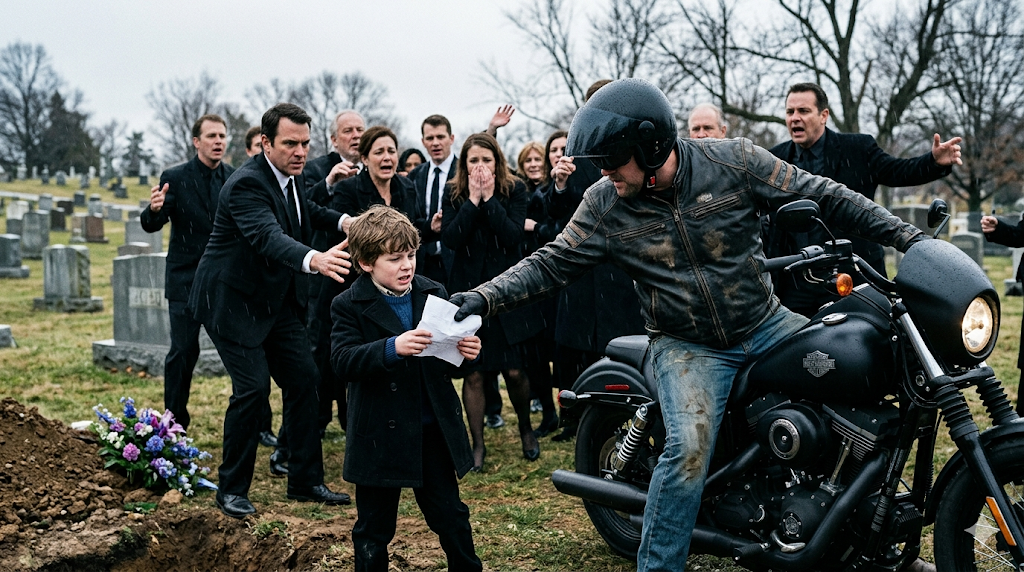
At the center of the thinning crowd stood a ten-year-old boy named Tucker Lane. He held a folded sheet of paper so tightly his fingers trembled around the edges. His eyes were glassy, his jaw clenched as if crying would crack something inside him that he couldn’t afford to break in public.
His mother’s grave didn’t even have a stone yet — only a temporary marker, the soil still dark and raw.
A few steps away, his father, Evan Lane, stared at the dirt like he couldn’t recognize it. He was thirty-eight, but grief had drained him into someone older. Unshaven, shoulders slumped, eyes unfocused, he looked like a man who’d been standing upright on habit alone.
Someone near the back whispered, “He hasn’t said a word all day.”
Another voice answered softly, “Some men don’t know where to put it when it hurts this much.”
Tucker stepped forward, lifted the folded paper, and pressed it gently against the temporary marker as if he were pinning it there for his mother to find.
“You weren’t supposed to leave,” he choked out, the words rough and thin.
Evan flinched like he’d been struck. His eyes tightened, but he didn’t move.
The wind rolled through the cemetery again, lifting fallen leaves and the corners of damp funeral programs someone had dropped. The world kept breathing even when Tucker felt like his own lungs had forgotten how.
And then a new sound cut across the quiet.
An engine.
Not loud, not wild — just sharp enough to turn heads.
A single Harley rolled slowly along the cemetery path, tires crunching gravel with deliberate restraint. It didn’t race, didn’t rev for attention, didn’t pretend the place belonged to it. It simply moved forward and stopped near the small cluster of mourners like it had a reason to be there.
The rider swung his leg over and removed his helmet.
Mid-forties. Weathered face. Leather vest worn soft at the seams. Forearms marked with old ink. His eyes weren’t curious — they were focused, like someone scanning a room for the one detail everyone else missed.
For a moment the crowd stared, unsure whether to be offended or confused.
Before anyone could form a full thought, the man walked straight toward Tucker.
Tucker’s grip tightened around the letter.
The rider reached out.
And with one swift motion, he took the folded paper from the boy’s hands.
Tucker’s face jolted with shock, then fury and fear crashed over it like a wave.
“Give it back!” he screamed, the sound raw enough to make several people gasp.
A ripple of outrage moved through the onlookers. Someone muttered, “What is wrong with him?” Another voice sharpened, “That’s a child.”
Evan stepped forward, voice scraped raw. “Sir. That belongs to my son.”
The rider — his name was Reed Callahan, though no one in that crowd knew it — didn’t shove the boy. He didn’t bark at him. He held the letter firmly, jaw set not cruelly, but with the kind of tightness that comes from someone who has seen something he cannot ignore.
He looked at Evan.
“I know it does,” Reed said quietly. “But there’s something in here you need to hear first. Both of you.”
The man in the navy suit near the back stepped forward again, face red with moral certainty. “Who the hell are you?”
Reed didn’t answer him. He looked only at Evan.
“My name is Reed Callahan. I rode with your wife’s brother, Marcus, for eleven years. He passed two winters ago — lung cancer. Before he died, he asked me to find this letter if anything ever happened to Claire.”
The name — Claire — landed in the center of the crowd like a stone dropped into still water. Rings spread outward. People went quiet.
Evan’s jaw tightened. “How did you—”
“She mailed it to Marcus four months before she passed,” Reed said. “She told him: if she didn’t make it, and if Tucker found it before Evan could explain things — she needed someone to be there to read it out loud. She was afraid the boy would misunderstand.”
Tucker had stopped pulling at the vest. He stood very still now, eyes locked on Reed’s face, breathing in small, careful increments.
“Misunderstand what?” Tucker whispered.
Reed looked down at the boy. Something in his expression shifted — not soft exactly, but careful. The way a man handles something he knows could break if he’s not steady.
“Your mom wrote you a letter,” he said. “But she wrote your dad one too, tucked inside the same fold. She was afraid you’d find yours first and think she was blaming herself. Or worse — think that she left on purpose.”
The silence that followed was total.
Tucker blinked. Once. Then his chin began to tremble.
Reed unfolded the letter slowly and held it open — not to the crowd, not for spectacle, but angled toward the boy and his father so only they could see. He read it in a low voice, the kind that carries only as far as it needs to.
“Tucker. If you’re reading this, it means I ran out of time to say these things out loud. I’m not sorry for loving you so hard it hurt. I’m not sorry for the Tuesday pancakes or the terrible knock-knock jokes or the way I used to sneak into your room just to watch you sleep when I thought you didn’t know. I’m sorry I couldn’t stay. But I need you to know — leaving was never a choice I made. It was the only thing that was ever taken from me against my will. Don’t carry that, baby. That weight was never yours.”
Reed paused. His jaw worked once.
“And then there’s a second part,” he said, looking at Evan. “She wrote it to you.”
Evan Lane — a man who had not cried once the entire morning, who had stood beside his wife’s coffin with the composure of someone already wrung dry — pressed the back of his hand against his mouth.
Reed continued reading.
“Evan. You are going to think you failed me. You are going to replay every doctor’s appointment, every night you fell asleep on the couch instead of next to me, every argument we had about small things that don’t matter now. Stop. None of it would have changed this. You gave me ten years of a life that felt like more than most people get in thirty. What I need from you now is simple: stay soft for Tucker. The world is going to try to make him hard, and only you can stop that. Be the kind of man he becomes. That’s all I ever asked.”
When Reed finished, he folded the letter carefully — the way you fold something that doesn’t belong to you — and he placed it into Evan’s hands.
Neither father nor son said anything.
Tucker moved first. He stepped forward and pressed himself against his father’s side, face buried in the fabric of Evan’s coat, arms wrapped around his waist. Evan’s hand came down on his son’s head, and then his knees buckled — not all the way, just enough to bring him low, bring him close, so that he was folded over Tucker and Tucker was folded into him, and the two of them became one shape in the middle of the empty cemetery while the sky stayed grey and the wind moved quietly around them.
The crowd had gone completely still.
The man in the navy suit had uncrossed his arms. The woman near the fence was pressing a hand to her sternum. Even the leaves seemed to have stopped moving.
Reed Callahan put his helmet back on.
He didn’t wait to be thanked. He didn’t explain himself further to the crowd or accept any of the tentative looks of reconciliation that a few people were starting to offer. He walked back to his Harley, mounted it in one practiced motion, and started the engine — low and steady and careful.
As he rolled back down the cemetery path, Tucker lifted his head from his father’s coat just long enough to watch him go.
“Dad,” he said, voice thick.
“Yeah, bud.”
“Mom knew. She planned for everything, didn’t she.”
It wasn’t really a question.
Evan Lane looked down at the folded letter in his hands, then at the temporary marker, then at his son’s face — still grief-wrecked, still ten years old, still trying to be brave in a way no child should have to be.
“Yeah,” he said quietly. “She really did.”
He sat down in the grass right there beside the grave — suit and all, damp October earth be damned — and pulled Tucker down beside him. And the two of them stayed there while the last of the funeral guests drifted away and the cemetery settled back into its grey and patient quiet.
Somewhere on the road outside the cemetery gates, the sound of the Harley faded, then disappeared entirely.
Tucker leaned his head against his father’s shoulder.
Evan opened the letter again and read it from the beginning, just for himself, without speaking.
He read it twice.
Then he folded it along the same creases Claire had made and slipped it into the inside pocket of his coat, close to his chest.
The temporary marker had her name on it: Claire Anne Lane. Beloved Wife and Mother.
No dates yet. No stone. Just her name against the raw earth, in a place where the world was still catching up to the fact that she was gone.
But the letter was real. The words were real. The promise she’d made in secret — that she’d thought of them, both of them, and left something behind to hold them together — that was as real as anything Evan had ever touched.
He put his arm around Tucker.
Tucker leaned in.
The sky stayed grey, and the wind kept moving, and the two of them stayed beside her until the light began to go.