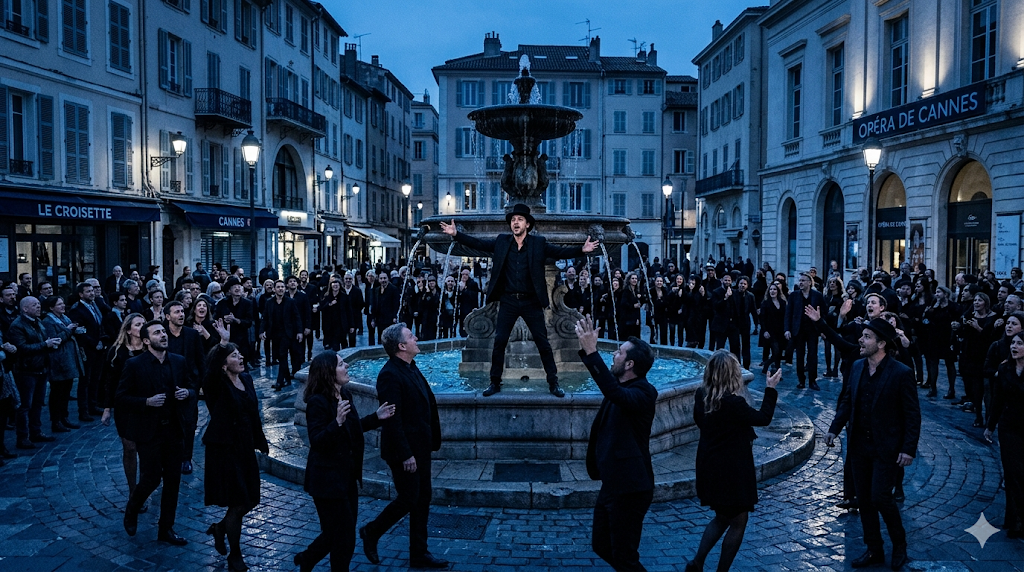
How One Man’s Voice Stopped an Entire French City Square
The Square That Sang
The morning had started like every other morning in Cannes — salt in the air, espresso on every table, and the lazy golden light that makes the Côte d’Azur feel like a postcard someone forgot to send. The fountain in the center of the square gurgled in its patient, civic way, spelling out the city’s name in white block letters that tourists photographed and locals ignored. Pigeons negotiated with croissant crumbs. A waiter in a black apron dragged a chalkboard menu through a door. Children chased each other around the legs of wrought-iron chairs.
Isabelle Marchetti had been sitting at the corner café for forty minutes, nursing a café crème she had already let go cold twice. She was supposed to be answering emails. She was, instead, watching people — her oldest and most inexcusable habit. Her laptop sat open in front of her like a polite accusation, its screen dimming in protest.
She noticed him first because of the shoes.
Red sneakers, so aggressively bright against the pale stone of the square that they looked computer-generated. The man wearing them was perhaps thirty-five, unremarkable in every other way — dark jeans, a gray linen shirt, a weekend bag slung over one shoulder. He walked through the square like someone who had somewhere to be, which is to say, purposefully. He reached the fountain. He stopped. He set down his bag with the careful deliberateness of someone who had rehearsed this moment.
Then he turned around, looked at the square — the cafés, the tourists, the ambling locals, the pigeons — and opened his mouth.
What came out was not a shout or a speech or a sales pitch. It was a note. A single, held, operatic note, deep and warm and enormous, the kind of sound that seems to come from somewhere below the chest. It rose from him like steam from summer pavement, filled the mouth of the square, bounced off the pastel facades, climbed the shuttered windows.
Every head turned.
He was a tenor — or something close to it — and the note resolved into the opening phrase of O Sole Mio, which is perhaps the most Italian thing that can happen to a French square, and yet it felt completely right. His voice had that particular quality of voices that are not merely singing but insisting — insisting that you stop, that you look, that you, for one suspended moment, be exactly where you are.
Isabelle set down her coffee.
For ten seconds — and ten seconds is a long time when everyone in a public square has suddenly stopped moving — he sang alone. A woman at the next table pressed her hand to her mouth. A teenage boy lowered his phone, which said something.
Then, from the café directly behind Isabelle, a chair scraped back.
She turned. A woman in her sixties, silver-haired, wearing a yellow linen dress and sensible sandals — the kind of woman you would guess was a retired schoolteacher or perhaps a very organized grandmother — stood up, cleared her throat with the composure of someone about to address a board meeting, and joined him.
Her soprano was not professional. It was something better: it was true. Unpolished and unashamed, it rose from her like something she had been saving for exactly this moment, harmonizing with the tenor at the fountain with the ease of two instruments that have always been tuned to each other.
The square held its breath.
Then it erupted.
Not with applause — not yet. With voices.
From the far corner, a man in a bicycle helmet who had been locking his bike to a signpost let go of the chain and began to sing bass. From a second-floor balcony, a window flew open and a young woman leaned out, laughing and adding her voice to the mix. A tour guide who had been lecturing a cluster of disinterested Americans about architectural history simply stopped mid-sentence, raised one hand like a conductor, and became one instead — swaying, encouraging, eyes closed.
A child tugged at her mother’s sleeve. “Maman, why are they—”
“Shh,” said the mother, who had also started crying, which confused the child enormously.
Isabelle sat very still.
She had lived in Cannes for three years. She had moved here from Lyon after a divorce that had been amicable in the legal sense and devastating in every other, trading a shared apartment and a shared life for a studio near the port and the dubious consolation of the sea. She had told herself she was reinventing. She had mostly been hiding. She answered emails. She went to the market on Saturdays. She let her coffee go cold.
Now she was sitting in a square that was singing to her.
More voices joined — she counted, later, when she tried to explain it to her sister: there were at least forty people performing, woven into the life of the square so naturally that it was impossible to tell where the performance ended and the audience began. The tenors and sopranos at the fountain had been joined by what she could only describe as a chorus of civilians: a fisherman, two teenage girls who clearly knew the words by heart, a man in a business suit with his jacket over his arm who sang with his face tilted up at the sky like he was reading from it.
The melody shifted — O Sole Mio opening into something more complex, a medley that moved through Puccini and Verdi and something she didn’t recognize, something folky and warm that several of the older locals seemed to know by heart and sang the loudest, as if this particular song were a code, a handshake, a way of saying I am from here and you are from here and isn’t that remarkable.
Isabelle became aware that her face was wet.
She was not a crier. Or she had not been, for a long time. She had cultivated, carefully and deliberately, the French emotional discipline of finding things intéressant rather than bouleversant — interesting rather than overwhelming. She had gotten very good at it. She had not cried at the divorce, not really, not the ugly inconvenient kind. She had not cried when she left Lyon. She had not cried when she realized, about eighteen months into her new solitary life in Cannes, that she had successfully arranged herself into a kind of elegant, sunlit loneliness.
But here she was, in a café on a Tuesday, crying at strangers.
The woman in the yellow dress had made her way to the fountain during the performance and now stood beside the tenor with the red shoes, both of them facing the square, both of them singing with their whole bodies in that particular operatic way that looks nothing like actual singing and everything like an act of survival. Around them, the amateur chorus had arranged itself with a naturalness that was almost choreographic: the bass near the left archway, the two teenage girls perched on a low wall, the fisherman and the man in the suit standing shoulder to shoulder as if they had known each other for years.
The tour guide was weeping openly and had given up any pretense of conducting.
And then — this is the part that Isabelle would struggle to describe later, the part that always made her feel slightly insane when she tried — the square itself seemed to change. Not the buildings, not the stone, not the pastel facades or the wrought iron or the fountain with its civic letters. But something in the light. Something in the quality of the air. The afternoon rearranged itself around the music, the way water rearranges around a stone — not broken, just different. Deeper.
She thought: I have been missing this. Not just today. For a very long time.
The final note held — the tenor and the soprano and all forty unofficial voices, held together in the warm blue air of the Côte d’Azur — and then it resolved, gently, like a question being answered.
Silence.
One second of perfect silence, which is the rarest thing in any city square.
Then the applause. Enormous, generous, slightly desperate applause, the kind that is really saying thank you for reminding me, the kind that has nothing to do with performance and everything to do with something that had briefly opened in everyone who had been standing there, some window left unlocked.
The tenor in the red shoes took a bow. The silver-haired woman laughed and covered her mouth with both hands. People reached out to shake each other’s hands, to say did you know him, did you organize this, what was that, and the answer everywhere was the same: no, no, I just heard it and I had to, I don’t know, I just—
Isabelle opened her laptop.
She closed it again.
She ordered another café crème and let it go cold, because she was busy watching the square return to itself — the pigeons, the children, the waiters, the slow Mediterranean afternoon — all of it carrying now some faint residue of the thing that had just happened, some shimmer that would, she thought, take a very long time to fade.
She thought about Lyon. She thought about the divorce. She thought about eighteen months of elegant loneliness.
She opened her laptop.
This time, she did not open her email.
She opened a search engine and typed: community choirs Cannes.
Outside, the tenor with the red shoes shouldered his bag, smiled at no one in particular, and walked out of the square the same way he had walked in — with purpose, as if he had somewhere to be.
He did. He always did.
There were other squares. Other Tuesdays. Other people letting their coffee go cold.