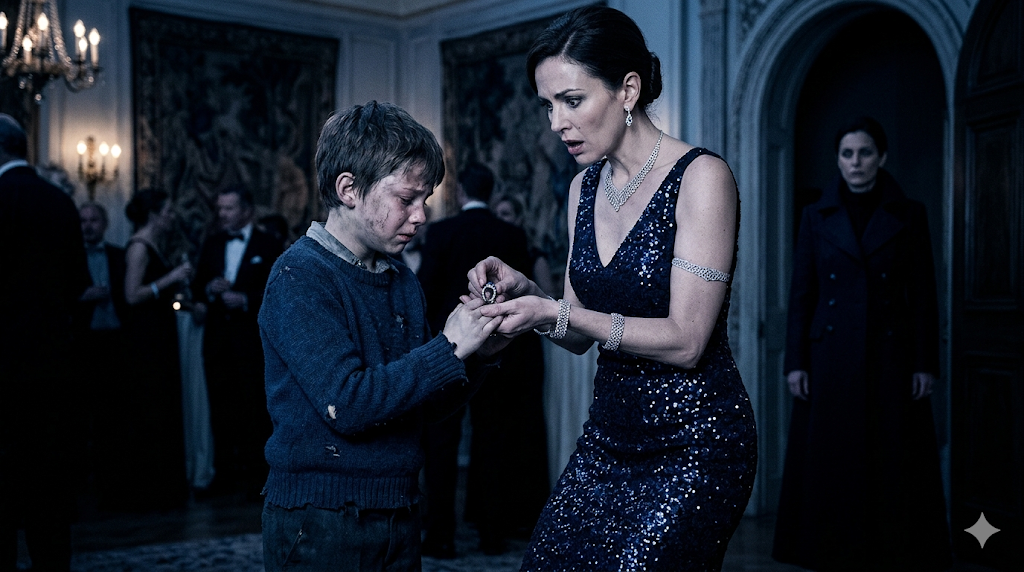
A filthy, crying boy grabbed a diamond-clad woman at a black-tie gala and pressed a piece of her dead sister’s jewelry into her palm 💎😱
The night smelled like money.
That particular kind of money — old, quiet, and unashamed of itself. Gardenia centerpieces floated in crystal bowls. String lights hung overhead like a constellation someone had purchased and imported for the evening. Waiters moved between tables with the practiced invisibility of people trained to be furniture, lifting empty glasses, replacing them with full ones, never making eye contact unless invited.
Genevieve Ashworth had hosted this party eleven years in a row.
It was a fundraiser, technically. A charity gala for children’s literacy, which she found meaningful enough to lend her name to and generous enough to fund with other people’s donations. She sat at the center of it all in a column gown of midnight blue, her dark hair swept into a sleek chignon at the base of her neck, diamonds catching the string light glow at her throat and ears like she had been designed specifically for this evening.
She probably had been.
“You look extraordinary,” said a man beside her — Marcus, her husband of nine years, a corporate attorney with silver at his temples and an easy smile that had never once looked uncomfortable in any room. He touched her bare shoulder as he said it, the gesture practiced, fond. “Every year.”
“Every year,” she agreed, and smiled.
The smile came naturally. It always did.
Genevieve had spent the better part of three decades perfecting the architecture of ease — the way to sit in a room full of people who were watching you without letting any of them see that you were watching back. She had learned it from her mother, who had learned it from hers: women in this family did not flinch. They did not crack. They did not let the world see the machinery behind the performance.
Her mother was gone now. Her father was gone. And her sister—
She didn’t finish that thought.
She never did.
The evening moved the way these evenings always moved: toasts and canapés, a brief presentation on the foundation’s annual reach, a live auction for a week in the Maldives that two men from separate finance firms bid on with the particular aggression of people who didn’t actually want the trip. Genevieve laughed at the appropriate moments. She touched her husband’s arm. She leaned into the conversations offered to her and extracted herself from them gracefully when they ran long.
It was past nine when she excused herself from a cluster of guests near the bar and moved toward the edge of the terrace for a moment alone. Not a real moment — she wasn’t afforded those here — but a breath. A pause between sentences.
She was looking out toward the hedge maze at the far end of the garden when she felt it.
A grip at her arm. Small fingers. Tight.
She turned with the practiced patience of someone who expected a colleague’s child or a philanthropist’s eager grandchild — and instead found a boy she did not recognize, and would not have recognized even if he hadn’t looked the way he did: seven, maybe eight years old, his face pale and drawn beneath a layer of grime, hair dark and matted, wearing a button-down shirt that had once been white and was now the color of exhaustion. Tear tracks cut clean lines through the dirt on his cheeks.
He was looking at her with a desperation that had no place at this party.
“Hey — don’t —” he started, his voice breaking. He grabbed her arm harder, and then seemed to change his mind, stepping back, his eyes searching her face with something between terror and certainty. “Don’t touch me. She has the same hair.”
Genevieve blinked.
She was aware of the nearest table looking over. She pulled her arm back, her voice dropping to the polished murmur she used when situations needed containing. “I’m sorry — what? What are you talking about?”
“My mom,” the boy said. He swallowed. His hands were shaking. “My mom said I’d find you here.”
“Your mother—” She stopped. Something in her throat tightened without permission. “Who is your mother? Where is she? Are you lost, sweetheart, I can have someone—”
He opened his hand.
She looked down because she was meant to. The way you look when a child holds something out to you — reflex, kindness, the automatic gesture of an adult toward a smaller person.
And the world stopped.
There in his dirty, trembling palm lay a piece of jewelry she had not seen in seventeen years and had told herself — convinced herself — was buried.
A silver and diamond brooch in the shape of a climbing flower, three blooms cascading from a delicate stem, each petal edged in pavé diamonds so fine they almost looked like frost. Her grandmother had commissioned it in 1962. Her mother had worn it every year on her birthday until she gave it, privately, with almost no ceremony, to her younger daughter on the occasion of her eighteenth birthday.
To Lena.
Lena, who was dead.
Genevieve heard the sound she made only after she had already made it — a short, jagged exhale that she would later tell herself was not a gasp. Her hand moved involuntarily toward the brooch, then stopped. Her fingertips hovered over it without touching.
“That’s…” Her voice came out wrong. Hollow. “That’s impossible.”
The boy’s chin trembled. A tear slid down his cheek, and he looked up at her with the devastating patience of a child who had rehearsed this moment many times and was still not ready for it.
“She said you’d say that.”
Something cold moved through Genevieve’s chest — not ice, but the space where warmth should have been and wasn’t.
“Where is she?” she demanded. The murmur was gone. The polish was gone. Her voice came out sharp and too loud and she didn’t care because she could feel the edges of the world she had built starting to reorient themselves around a fact that wasn’t possible. “Where is she? Who gave you that? Where did you get that, where is she—”
“She’s here,” the boy said simply.
And she was.
Genevieve heard the silence before she saw the source of it — that particular ripple that moves through a crowd when something has entered the room that wasn’t there before. The couple at the nearest table stopped speaking. A man in a tuxedo by the bar turned slowly, like something had called his name. Somewhere on the marble terrace, a champagne flute hit the ground and shattered, and no one reacted to the sound.
They were all looking at the hedge.
At the opening in the tall, dark, perfectly manicured green wall at the garden’s edge, where a lamp-lit path cut through to the outer grounds. The path was dimly lit and long, and at the far end of it, standing in the shadows just beyond the reach of the string lights, stood a woman.
She was wearing a darker dress, simple and dark-colored, unremarkable among evening gowns. She stood still with the quality of someone who had learned to make herself invisible and then chosen, very deliberately, to be seen. Her dark hair was down around her shoulders. She was thinner than Genevieve remembered, or perhaps Genevieve had simply remembered her wrong — idealized her, softened her, the way we do with people we have lost.
Behind her, slightly to the left, stood a man in a suit. He did not move. He watched.
The woman in the shadows watched too.
She was looking directly at Genevieve.
Genevieve’s hand found the diamond at her throat without thinking — a gesture she would have recognized in another woman as fear. The garden sounds had gone distant: the music, the soft conversation, the ambient warmth of three hundred people in formal wear enjoying a summer evening. All of it receded to a low hum at the edge of perception.
“That’s not possible,” she whispered to herself. To no one. To the empty space between where she stood and where her dead sister stood watching her.
The boy’s hand closed around the brooch again.
“She said that too,” he said quietly. “She says you always used to say that when things got real.”
The lights flickered — not actually, but it seemed that way. The world tilted two degrees and didn’t right itself. Genevieve’s husband was moving toward her from somewhere behind; she could hear him saying her name. Guests were turning, murmuring, watching the woman in the hedge opening who stood so still she might have been carved there.
Seventeen years.
Genevieve had ordered a coffin. She had delivered a eulogy. She had identified — no. She had been told. She had been told that a body had been identified, and she had believed it because the alternative required a universe she wasn’t prepared to inhabit.
But the alternative was standing at the end of a garden path holding a secret she had carried across seventeen years and sent ahead of her in the hands of a child.
And Genevieve’s face — for the first time in three decades of flawless performance, in front of three hundred people who would spend the rest of the evening talking about this moment — showed everything.
Her mouth was open.
Her eyes were wet.
She was not moving.
And then the lights went out.
Not all of them. The string lights above stayed on, casting the terrace in amber and gold. But the hedge path went dark, and when someone fumbled for their phone torch and aimed it toward the opening, the pathway was empty. The woman in the shadows was gone. The man beside her was gone.
Only the boy remained.
He stood in the middle of the terrace, looking up at Genevieve with calm, exhausted eyes, the brooch curled in his closed fist.
“She said she’ll find you,” he said. “When she’s ready.”
Marcus reached them. He put a hand on Genevieve’s back and leaned close. “Gen. Who is that? What’s happening?”
Genevieve looked at her husband. She looked at the boy. She looked at the empty hedge opening. She closed her mouth. She breathed in through her nose and out through her teeth, the old technique, the one her mother had taught her for when the world required you to be steadier than you felt.
She crouched down to the boy’s level.
“What’s your name?” she asked.
“Felix,” he said.
“Felix.” She held out her hand, palm up — not for the brooch, not yet. Just open. “Are you hungry?”
He looked at her hand for a long moment. Then he placed his small, dirty hand in hers.
“She said you’d ask that too,” he whispered.
Genevieve stood. She straightened her spine. She looked out at the party guests who had stopped pretending not to watch, and she gave them the smile that meant this is handled, and it was enough to make them turn back to their conversations the way well-trained guests do.
And then she walked Felix inside, away from the lights and the music and the three hundred witnesses, toward a room where she could sit down and find out what she had been living inside of for seventeen years — and what, exactly, had just come back to undo it.
The champagne flute was still in pieces on the marble.
No one had cleaned it up yet.
No one seemed to know quite where to start.