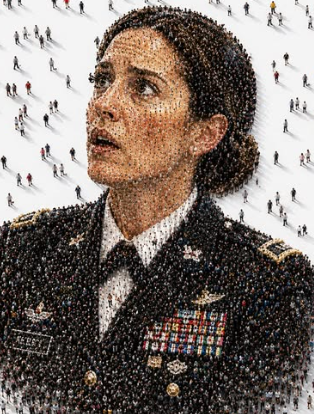
I Came Straight From A National Security Crisis. My Family Was Embarrassed By My Clothes.
I had been awake for thirty-seven hours when I walked into my sister’s engagement celebration—and the first thing Morgan did was grab my arm hard enough to bruise.
The ballroom at the Whitmore Grand smelled like money and orchids and damp wool coats, the kind of room where everything gleams and nothing is real. Crystal chandeliers. White tablecloths pressed to architectural precision. A jazz trio playing something soft and European near the far windows. My father stood in the center of it all with the men he collected—colonels whose careers had peaked in ceremony, politicians whose smiles were calibrated for flashbulbs.
I stood at the entrance in a working uniform with oil on my chest pocket and dust at my cuffs, because I had come directly from a classified operations bunker forty feet underground where I had spent the last thirty-six hours managing a containment event that put half the Eastern Seaboard one failed relay away from a very bad night.
Nobody in that ballroom knew that. Nobody was supposed to.
I crossed the threshold and the jazz weakened—not because the musicians noticed me, but because rooms like that have a physics of belonging, and I was a disruption in it. Brass thinned. A cymbal brushed once and stopped. Champagne glasses paused at lips. Someone near the back tilted their head the way people do when something doesn’t compute.
Morgan appeared before I’d taken ten steps.
She was white from collar to hem, engineered to be photographed. Her hair was pinned in a way that suggested it had taken two hours to look effortless. She had the smile she used for crowds already deployed—wide, warm, completely hollow—and she crossed the marble toward me with it aimed perfectly over my shoulder at the assembled guests.
When her fingers locked around my forearm, the smile didn’t move.
“What are you doing?” she said, barely above a whisper.
“I was told to be here.”
Her eyes dropped to the smear on my chest pocket. The oil. The cuffs. She took in the whole picture the way an appraiser takes in damaged inventory. “Not like this,” she said. “This is my night. Take that trashy uniform outside. Or just leave. You’re making everything ugly.”
She said it quietly. That was always Morgan’s particular skill—cruelty delivered at a pitch that only reached the target. The room went on celebrating around us. Nobody heard. Nobody was meant to.
I had a choice in that moment. The version of me that existed before clearance codes and containment binders and emergency checklists would have made a scene. Would have pulled my arm free hard enough to spill champagne down the white dress. Would have said something Morgan would have needed to carry for years.
Instead I let the rage go cold in my hands and nodded once and walked back out into the rain.
The cold hit the way cold always does when you’ve been inside too long—total and clarifying. The city moved on the street below, indifferent and clean. I had barely made it to my car when the doors behind me opened again and Julian came out still holding his champagne, rain darkening the shoulders of his tuxedo within seconds.
Julian Marsh. My sister’s fiancé. Thirty-eight, sharp-jawed, comfortable in tuxedos the way some men are comfortable in their own skin. He ran a private wealth consulting firm with twelve employees and a midtown office and an address in Tribeca that cost more than his disclosed income could explain. I had noticed the gap six months ago. I had not mentioned it to Morgan because it was not my place and because Morgan does not respond to information that conflicts with the architecture of her life.
He reached through my open car window and offered a folded document.
“Simple authorization,” he said. “Transfer your share of your grandfather’s trust into the house account. Morgan and I close on the property next month. Just a formality.”
The paper was already prepared. My full legal name typed above a signature line. My grandfather’s trust named in the header. A routing memo clipped behind it. The notary block filled in, the date already stamped, the receiving account number partially obscured under Julian’s thumb.
Not a request. An instrument.
“I’d rather not,” I said.
His voice changed in the way voices change when the first layer of pleasantry runs out. “Sign it,” he said. “We can keep things smooth.” Then the rest of it, soft and practiced: that there were positions available that would suit someone of my particular background. Lower pressure. More appropriate. A reassignment could be arranged by the right people. He said it without raising his voice, the way men who have been threatening people a long time learn to say things—dressed like concern, delivered like a loaded chamber.
A car swept past on the wet street and its headlights caught Julian’s wrist. The watch there was gold-cased, dark-dialed, the kind of piece that costs more than a mortgage payment. There was a stillness that settled into me right then—not anger, something quieter and more useful than anger.
Classification.
I have spent eleven years learning to see what a thing actually is rather than what it presents as. Julian Marsh was presenting as a future brother-in-law. What he actually was had a different name, and it was going to require documentation.
I declined to sign. He folded the paper back into his jacket with his jaw set and his charm visibly offline, and he left wet footprints on the marble steps going back inside.
I should have driven away.
At 8:43 p.m. my father called and told me to return for Morgan’s formal recognition speech. He did not phrase it as a request. My father never phrases things as requests.
By the time I returned the ballroom had shifted into ceremony configuration. Extra chairs. Dimmed overhead lights brought lower and brighter over the podium. The jazz trio had been replaced by silence and the soft sound of crystal shifting in well-dressed hands. Morgan stood at a microphone under a spot of white light, and she was giving a speech about sacrifice and duty and the weight of family.
She glanced my way about three minutes in. Her chin lifted a fraction.
“Some people,” she said, gently, almost tenderly, “simply can’t carry pressure the way others can. And that’s all right. Families accommodate.” She smiled at the room, and the room—full of decorated uniforms and pressed politicians and women in gowns designed not to be forgotten—responded with the particular silence of people deciding they understood.
Forks halted midway to mouths. Champagne glasses hovered. A colonel near the left table looked very carefully at his program. The woman beside him stopped smiling but did not speak. The chandelier went on shining. Ice clicked softly somewhere across the room.
No one moved.
My father appeared at my elbow. His cologne cut through the orchid smell. He leaned down far enough to be private.
“Tomorrow,” he said, “I’ll see to it your clearance is pulled.”
I looked at my watch. Not out of nerves. Out of discipline. The emergency protocol we had been running for the past eighteen hours was set to trigger a public alert only if the final relay failed its validation window—which closed at 9:07 p.m. If the alert sounded in this room, it meant the problem had not stayed contained. It meant it had followed me here farther than anyone in this building could begin to calculate.
At 9:04 p.m., every phone in the ballroom screamed.
Not a text notification. Not a call. An emergency alert—the kind that forces its way through silent modes and vibration-only settings because silence is not an option when it sends.
The music that wasn’t playing didn’t stop because there was no music. What stopped was everything else. A champagne flute shattered somewhere near the front. Officers came to their feet asking questions they didn’t have answers to. The doors at the rear of the ballroom came open and a military police unit moved through in a formation that changed the quality of the air.
My father moved to intercept them. They moved around him.
Morgan left the podium. They didn’t slow.
They weren’t there to secure the room. They were there for a person. The captain—senior, composed, operating with the specific economy of movement that comes from training and consequence—crossed the ballroom floor and stopped in front of my chair and held out a hardened communications tablet.
The room had gone entirely silent.
Morgan’s smile was gone. For the first time in my memory her face had no performance on it, only the blankness of someone realizing a story they thought they understood has a chapter they never knew existed.
My father stood very still. The composed men beside him had stopped composing. Something had shifted in the room’s understanding of who the important people were, and the shift had not resolved in his favor.
The captain’s voice was even and clear and pitched for the record.
“Major. There’s been a development in the Eastern relay containment. Command needs you back on-site. We have a vehicle outside.”
I stood. Took the tablet. Scanned the summary.
Then I looked at Julian, who had gone pale in a way his tan couldn’t quite hide, because a man who has just tried to coerce a military officer into signing fraudulent trust documents in a parking lot does not enjoy watching that officer be collected by military police.
I looked at my father, who had promised in a whisper forty minutes ago to have my clearance pulled, and who was now watching that clearance be exercised in a room full of the people he’d spent his life trying to impress.
I looked at Morgan. She was holding her champagne flute with both hands. The speech she’d been giving—about pressure, about who can carry it and who cannot—was still in the air above us, looking for somewhere to land.
I buttoned my jacket. The oil stain on my chest pocket caught the chandelier light.
I said nothing, because nothing needed to be said.
The military police unit formed up around me and we walked out of the Whitmore Grand through the front doors, which an officer held open, and into the rain.
Behind me I heard the ballroom begin to exhale. I heard questions start. I heard the shape of the evening rearranging itself around a new center of gravity.
My father had called my clearance an embarrassment. In the end it was the only thing in that room that turned out to matter.
Julian was arrested fourteen days later. The watch on his wrist, as it happened, traced to an account that traced to three others that traced to a pattern that people in my line of work recognized immediately. I submitted the initial flag the morning after the party.
Morgan called me six weeks after that. She didn’t apologize exactly. What she said was: “I didn’t know.”
I believe her. Morgan has always been excellent at not knowing the things that would require her to change.
I told her I was glad she was safe.
She asked if we could have dinner sometime.
I said yes, because I am still her brother, and because some debts you pay not because they’re owed but because you can afford to.
The relay held, incidentally. East Coast slept through it. Nobody knew how close it got, and that is exactly how it was supposed to be.
That’s the job. You carry it underground, in bad light, on bad coffee, and then you walk into a ballroom and your sister tells you to take your trashy uniform outside, and you let the rage go cold in your hands, and then you do the work anyway.
Because the work doesn’t wait for the room to be ready.