POV: Never judge someone by their appearance…
DIAMONDS DON’T LIE
The morning Mia Caldwell walked through the iron gates of Harrington Preparatory Academy, nobody looked twice. That was, of course, exactly the point.
She wore a plain white oversized tee, faded dark jeans, and a pair of worn-in sneakers that had seen better days. Her black hair was pulled back in a messy bun, no makeup, no jewelry — except for one thing. Looped around her slender wrist, glinting softly in the October sun, was a diamond tennis bracelet. Not costume. Not cubic zirconia. The real thing. Forty-eight brilliant-cut diamonds, two carats each, set in platinum, worth more than most people’s cars.
She didn’t think anything of it. It had been a gift from her father on her sixteenth birthday. She wore it every day. Like a habit. Like breathing.
Nobody at Harrington knew who Mia Caldwell really was.
That was also, of course, exactly the point.
PART ONE: THE NEW GIRL
Harrington Prep was the kind of school where the parking lot looked like a luxury car dealership. Where students carried designer bags to first period and complained about their allowances being cut to four figures. It was a school built on old money, maintained by new money, and attended by people who had never known a world without money at all.
Mia had attended schools like this before. Many of them. In Seoul. In Geneva. In London. In Dubai. She had learned, through years of quiet observation, that wealthy schools were full of a very specific kind of cruelty — the kind that wore a smile and smelled like expensive perfume.
She wasn’t here to make enemies. She wasn’t here to make friends, either.
She was here, as her father had arranged, to spend one semester living like a normal student. No security detail in view. No private driver dropping her off in a Bentley. No last name that would make teachers stand up straighter. Just Mia. Just a girl in jeans and sneakers, figuring out how to be ordinary.
Her father, Joon-Ho Caldwell, was the kind of man whose name opened doors in six languages. A South Korean-American tech and real estate magnate, he ran Caldwell Global Holdings — a company with more subsidiaries than most countries had cities. He was not famous the way celebrities are famous. He was famous the way mountains are famous. Quietly. Permanently. Unmistakably.
He had insisted on this experiment.
“You’ve lived your whole life surrounded by people who know who you are,” he’d told her, the evening before she enrolled. They were sitting on the terrace of their Malibu estate, the Pacific stretching out below them, tangerine-colored at sunset. “You need to understand what it’s like to be seen without all of that. Without the name. Without the security. Without the weight of it.”
“And if something goes wrong?” Mia had asked.
He’d smiled. “Marcus and Daniel will be nearby. But out of sight. You won’t need them.”
She had rolled her eyes, but she’d agreed.
That had been two weeks ago.
So far, Harrington Prep had been exactly what she expected: beautiful, cold, and quietly vicious. The hallways smelled like a department store. The cafeteria served grain bowls and cold brew. The girls wore their confidence like armor, and the armor, Mia had quickly noticed, was calibrated by a very precise social hierarchy.
At the top of that hierarchy sat Celeste Whitmore.
PART TWO: CELESTE
Celeste Whitmore was the kind of beautiful that made people nervous. Tall, polished, with bone-straight honey-blonde hair and sharp green eyes that catalogued everyone she passed, she moved through Harrington like she owned it — which, in a sense, she did. Her family had funded three of the school’s buildings. Her last name was on the library.
She had been the queen of this particular castle since the eighth grade, and she had maintained that position through a combination of charm, social intelligence, and an absolute ruthlessness toward anyone she perceived as a threat — or, more dangerously, as beneath her.
Mia had caught Celeste’s attention on day three.
It wasn’t anything Mia had done. She hadn’t spoken out of turn, hadn’t sat at the wrong lunch table, hadn’t looked at anyone sideways. But Celeste had clocked her — this quiet girl with the messy bun and the beat-up sneakers who didn’t seem to understand the social order — and something about her had pricked at Celeste like a splinter.
“Where did she even come from?” Celeste had murmured to her best friend, Priya, as Mia walked past the lunch terrace on day four. “She dresses like she shops at a gas station.”
Priya had laughed. “Transfer student. I think she’s on scholarship or something.”
Celeste’s eyes had narrowed. “She doesn’t belong here.”
That judgment, once made, was rarely reversed.
Over the next ten days, it had escalated in the subtle, deniable ways that Celeste’s cruelty always did. A chair pulled away just as Mia sat down. A group that stopped talking the moment Mia walked up. A comment — loud enough to be heard, quiet enough to be denied — about the state of her shoes.
Mia had absorbed all of it. She was good at absorbing things. She’d had practice.
But she hadn’t left. And she hadn’t changed.
And that, more than anything, had enraged Celeste.
PART THREE: THE COURTYARD
It happened on a Tuesday. Two weeks and three days into Mia’s enrollment at Harrington Prep. It was lunchtime, and the central courtyard was full — maybe sixty or seventy students scattered across benches and tables in the cool autumn air, the low buzz of a hundred conversations humming beneath the blue sky.
Mia was crossing the courtyard, heading toward the east wing, when Celeste stepped deliberately into her path.
“Hey.” Celeste’s voice was sweet. That was always how it started — sweet, like something spoiling.
Mia stopped. “Hey.”
“I’ve been meaning to ask you something.” Celeste tilted her head, the picture of casual curiosity. Behind her, three of her friends drifted closer, their expressions already anticipating something.
“Okay,” Mia said.
“Where do you even get the money for tuition here?” Celeste asked pleasantly. “Scholarship fund? Financial aid? Your parents working two jobs?”
Around them, a few nearby students had gone quiet, tuning in.
Mia looked at her steadily. “Does it matter?”
“I’m just curious.” Celeste smiled. “I like to know who I’m going to school with. What kind of people, you know?” Her eyes moved deliberately down Mia’s outfit. “Some people don’t exactly…fit.”
“I fit fine,” Mia said, and started to move past her.
That was when Celeste shoved her.
It wasn’t a gentle push. It was a sharp, hard shoulder-check, the kind designed to knock someone off balance, to humiliate rather than hurt. Mia’s sneaker caught on the uneven cobblestone and she went down, hard, catching herself on her palms. Her phone skittered across the stone.
The courtyard went silent.
Then it exploded — in the hiss of fifty drawn breaths, in the rustle of students turning, in the rapid tap of a dozen phone screens recording.
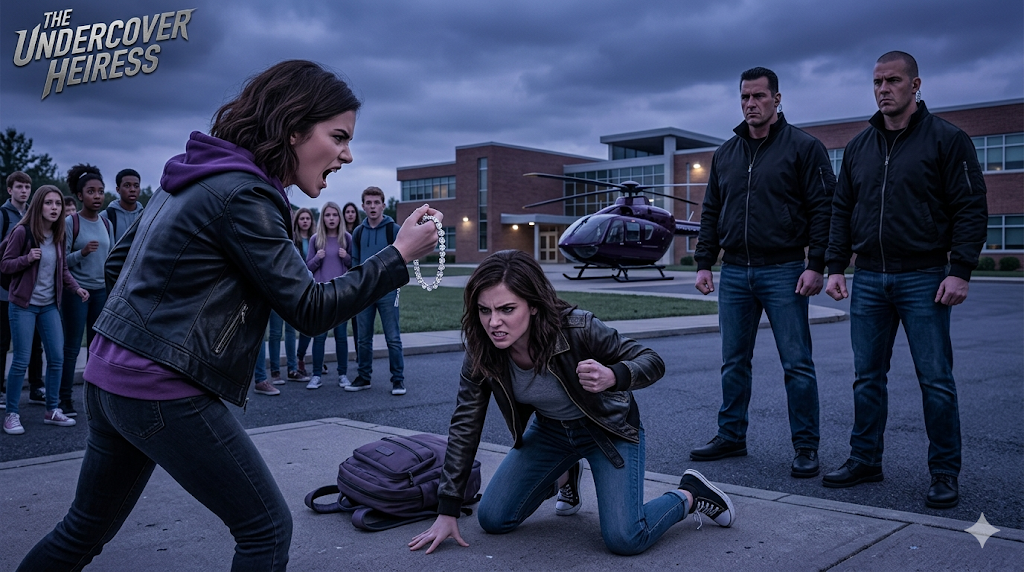
Celeste stood over her, enjoying the moment. Then her eyes dropped to Mia’s wrist — to the bracelet, which had twisted around and was now catching the light brilliantly, throwing tiny prisms across the courtyard stones.
Something shifted in Celeste’s expression.
She reached down.
And she snatched the bracelet from Mia’s wrist.
She held it up between two fingers, examining it theatrically, turning to the watching crowd with an expression of exaggerated suspicion.
“Is this real?” she announced, loud enough for everyone to hear. “Where did you get this?” Her voice dropped into something sharp and contemptuous. “Did you steal that?” She looked down at Mia on the ground, her green eyes cold. “Girls like you don’t wear diamonds.”
The words landed like stones into still water. Rings spreading outward.
Mia lay still for one breath. Two. Three.
Then she opened her eyes.
PART FOUR: THE BRACELET COMES BACK
If anyone had been paying close enough attention — and afterward, many of them would say they should have been — they would have noticed that Mia’s expression, looking up from the courtyard stones, was not what it should have been.
Not embarrassed. Not afraid. Not even angry, exactly.
Focused.
Like someone powering on.
She moved.
Not slowly, not fumblingly, not the way someone who had just been shoved to the ground moves. She moved the way water moves — immediately, completely, without hesitation. In a single fluid motion she had swept her right leg in a low, devastatingly precise arc — a technique called a de ashi barai in judo, a foot sweep executed at exactly the right moment of weight transfer.
It connected with Celeste’s right ankle at the precise instant Celeste’s weight was on it.
The result was immediate and absolute.
Celeste’s feet left the ground. She went airborne — arms pinwheeling, honey-blonde hair flying — and landed on her back on the courtyard stones with a sound like a door slamming. The bracelet flew from her hand and arced through the air.
Mia was already standing.
She caught the bracelet without looking at it, her gaze still on Celeste, and clasped it back around her wrist in one practiced motion.
The courtyard was frozen. Sixty students, silent. Recording. Watching.
Celeste lay on the stones, winded, blinking at the sky, her carefully constructed image shattered as completely as she’d tried to shatter Mia’s.
Mia looked down at her. Her expression was almost gentle.
“You okay?” she asked. It wasn’t sarcastic. It was something quieter than that.
Celeste tried to say something, but the fall had knocked the air out of her lungs, and nothing came out but a thin, wheezing sound.
PART FIVE: THE REVEAL
And then the crowd parted.
Not because anyone asked them to. Not because there was any pushing or commotion. They parted the way people part when something makes them instinctively step back — when the atmosphere shifts in a way that can’t quite be named.
Two men stepped forward.
They were large — not bodybuilder-large, but the kind of large that comes from years of professional training, the quiet, functional size of people whose job involves putting themselves between danger and someone else. They wore identical black suits, crisp white shirts, no ties. Their expressions were perfectly neutral, perfectly alert, perfectly, unmistakably professional.
They positioned themselves on either side of Mia, not touching her, not hovering — just there. Present. Flanking.
One of them — the taller one, with silver at his temples — glanced briefly at Celeste on the ground, then looked at Mia. His voice was low and even, completely unremarkable except for the fact that it cut through the silence of sixty people like a knife through water.
“Miss Caldwell. The helicopter is on standby at the roof pad. Your father sends his regards. He asks if you’d like to reschedule your afternoon meetings.”
Not one person in the courtyard moved.
Not one person breathed.
Mia considered this for a moment. She reached into the pocket of her jeans and withdrew a pair of sunglasses — small, understated, worth more than most people’s rent — and slid them on.
She looked down at Celeste.
Celeste was staring up at her, the color gone from her face, her mouth slightly open. On the ground, in her expensive skirt, with her perfectly applied makeup and her family name on the library, she looked very small.
“Caldwell,” she said. Barely a whisper. “You’re — your father is Joon-Ho Caldwell?”
Mia tilted her head slightly. “Next time,” she said, “learn who you’re talking to.”
She turned.
The crowd parted for her the way it had never parted for Celeste — not from admiration, not from fear exactly, but from something more complicated. A recognition. A recalibration.
Her two bodyguards fell into step beside her, perfectly synchronized, and the three of them walked toward the east wing without looking back.
Behind them, Celeste Whitmore sat on the courtyard stones in the October sunlight, surrounded by sixty silent classmates, and tried to understand what had just happened to her life.
PART SIX: AFTERMATH
Word travels fast in a school like Harrington Prep. By sixth period, every student in the building knew. By the time the final bell rang, it had been confirmed, expanded, embellished, and sent in about forty different group chats.
Mia Caldwell. The girl in the worn sneakers and the faded jeans. The quiet transfer student everyone had dismissed. Daughter of Joon-Ho Caldwell. One of the hundred wealthiest private individuals in the world. Worth, by most estimates, somewhere north of eight billion dollars.
The diamond bracelet — the one Celeste had grabbed off her wrist and called stolen — was reportedly insured for nine hundred thousand dollars.
Celeste Whitmore did not come to school the next day.
Or the day after that.
When she returned, five days later, she was quieter. The armor was still there, but something beneath it had changed — a small, permanent crack where confidence used to be seamless. She walked the halls more carefully. She chose her words more carefully.
Nobody brought up the courtyard directly. But nobody had to.
Priya, who had been standing there, who had watched it all happen and had recorded most of it on her phone, found herself thinking about it for weeks afterward. Not about Celeste — she’d expected Celeste’s fall, eventually, in some form. But about Mia. About the stillness she’d had on the ground, looking up. About the way she’d stood up — not angry, not triumphant, just…awake.
About the word Mia had said, at the end.
Next time.
Not a threat, exactly. More like a reminder. A small, clear, permanent reminder that the world is full of people you don’t know yet, whose lives run in directions you can’t see, who are carrying things you can’t imagine from the outside.
And that the bracelet on the wrist of the girl in worn sneakers might just be the least remarkable thing about her.
PART SEVEN: THE CONVERSATION THEY DIDN’T HAVE
That evening, Mia sat on the edge of her temporary apartment’s roof terrace — a modest place by her standards, clean and quiet, three blocks from school — and called her father.
“Marcus says there was an incident,” her father said, without preamble.
“Minor,” Mia said.
“He says you took someone down.”
“She grabbed my bracelet.”
A pause. “The birthday bracelet?”
“Yes.”
Another pause, longer. “Are you alright?”
“I’m fine, Dad.”
“Do you want to come home?”
Mia looked out at the city. The lights were coming on, amber and gold, the way cities come alive at dusk.
“No,” she said. “I want to finish the semester.”
“Why?”
She thought about it honestly. About Celeste on the stones. About the sixty silent students with their phones. About the way the crowd had parted at the end — not for her, really, but for the idea of her. The version of her that came with bodyguards and helicopters.
“Because I want to understand something,” she said finally.
“What?”
“What it’s like when they don’t know.”
Her father was quiet for a moment. Then, very quietly, he said: “And what did you learn?”
Mia wrapped her fingers around the bracelet. Forty-eight brilliant-cut diamonds, two carats each. The most ordinary extraordinary thing she owned.
“That most people,” she said, “are exactly who they seem to be. And that’s not always a good thing.”
She heard her father exhale — not quite a laugh, but close.
“Come home when you’re ready,” he said.
“I will,” she said.
She sat there until the last of the light was gone, the bracelet glinting in the dark, and thought about diamonds. How they’re formed. Pressure, and heat, and time — enormous time, below the surface, invisible. You’d never know, holding one in your hand, what it had been through to get there.
You’d never know by looking.
That was, she supposed, exactly the point.
— END —