I Paid For A Stranger’s Diapers – He Only Had $4 Left
I paid for a struggling mother’s diapers when she was $4 short at my register… But a week later, an envelope arrived at my job that turned my entire world upside down.
The fluorescent lights of “Quick-Stop #42” didn’t just illuminate the aisles; they buzzed with a low, rhythmic hum that seemed to vibrate inside my skull. It was 11:30 p.m. on a Tuesday, the kind of hour where the world feels thin, like you could poke a finger through the atmosphere and touch the void.
I had been working the late shift for seven years. I knew the regulars—the tired truckers, the jittery night-shift nurses, and the local ghosts who just walked the aisles to feel less alone. But she was different.
When the door chimed, the sound felt heavier than usual. She stepped in, her boots damp from the light drizzle outside. On her shoulder sat a toddler, no more than two, his head tucked into the crook of her neck. He was out cold, his tiny, rhythmic breaths the only peaceful thing in the room.
She didn’t look at me. She looked at the floor, then the shelves. She moved with a strange, mechanical precision, grabbing a gallon of milk and a loaf of bread. Then she stopped at the baby aisle. I watched her through the security monitor. She stared at the diapers for a long time—minutes, maybe. She picked up a small pack, looked at the price, put it back, and then picked up a larger one, her lips moving as if she were performing complex calculus in her head.
When she reached the counter, the exhaustion coming off her was palpable. It wasn’t just “I need a nap” tired; it was “I have been carrying the weight of the world for a decade” tired.
“Just these,” she whispered.
I scanned them. Milk. Bread. Diapers. “That’ll be $21.42,” I said softly, trying not to wake the boy.
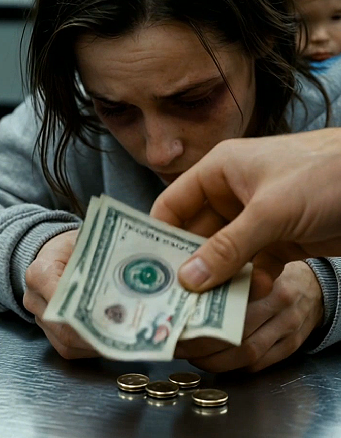
She began to dig. She pulled out a handful of change, a crumpled five-dollar bill, and a few ones. She counted them once. Twice. Her fingers were shaking—not from the cold, but from the realization.
“I’m… I’m sorry,” she said, her voice cracking like dry parchment. “I thought I had twenty-two. I’m short. I’m $4 short. Can I… can I put the diapers back? I’ll just take the milk.”
I looked at her. I looked at the sleeping kid. I thought about my own bank account, which had exactly $14 until Friday. But I also thought about how many times I’d stood in a line, wishing for a miracle that never came.
“Don’t worry about it,” I said, reaching into my own pocket and pulling out four singles I’d set aside for my bus ride home. I swiped my employee card to clear the balance. “I’ve got it. Just get him home and get some sleep.”
She froze. For a second, I thought she was going to be offended. Then, a single tear tracked through the dust and fatigue on her cheek. She didn’t say a million words. She just breathed out a “Thank you” that sounded like a prayer. She adjusted the boy, grabbed her bags, and disappeared into the neon-streaked rain.
A week passed. I forgot about it, honestly. You have to forget things in this job, or the sadness of the world eats you alive.
On Monday, my manager, Miller—a man who usually only spoke to me to complain about the trash cans—called me into his glass-walled office. He looked pale.
“Elias,” he said, holding a heavy, cream-colored envelope. “Did you cover a customer’s bill last week? Some woman with a kid?”
My heart hammered against my ribs. “Yeah. I paid for it myself, Miller. It didn’t come out of the drawer, I swear. If it’s against policy, I—”
“Shut up and read this,” he interrupted, sliding the envelope across the desk.
I opened it. Inside was a letter written on thick, embossed stationery.
Dear Elias, Last Tuesday, I was at the lowest point of my life. My husband had left, my accounts were frozen during the legal battle, and I had just spent my last ‘hidden’ cash on gas to get to my sister’s house across the state. I was $4 away from failing my son. You didn’t just give me diapers; you gave me the strength to keep driving. My father always told me to look for the ‘helpers’ in the dark. He passed away last year and left me his firm—but he also left me a mandate to find people like you.
I looked at the bottom of the letter. It was signed by the CEO of a massive logistics corporation headquartered downtown.
Underneath the letter was a check for $4,000—a “repayment with interest,” she called it. But there was something else. A smaller card with a phone number and a note:
“We need a Head of Operations for our night-shift distribution center. Someone who knows how to manage people with empathy and handle a crisis with grace. Call me Monday morning. Your gas station days are over.”
I looked up at Miller. He just nodded toward the door. “I think you should go make that call, kid.”
My hands didn’t stop shaking for three days.