1. He Offered a 7-Year-Old $1,000,000 as a Joke. She Knew His Secret
Chapter 1: The Palace of Humiliation
They foolishly believed they could use my daughter as entertainment. But they forgot one brutal truth: the most innocent eyes often see the most carefully hidden lies.
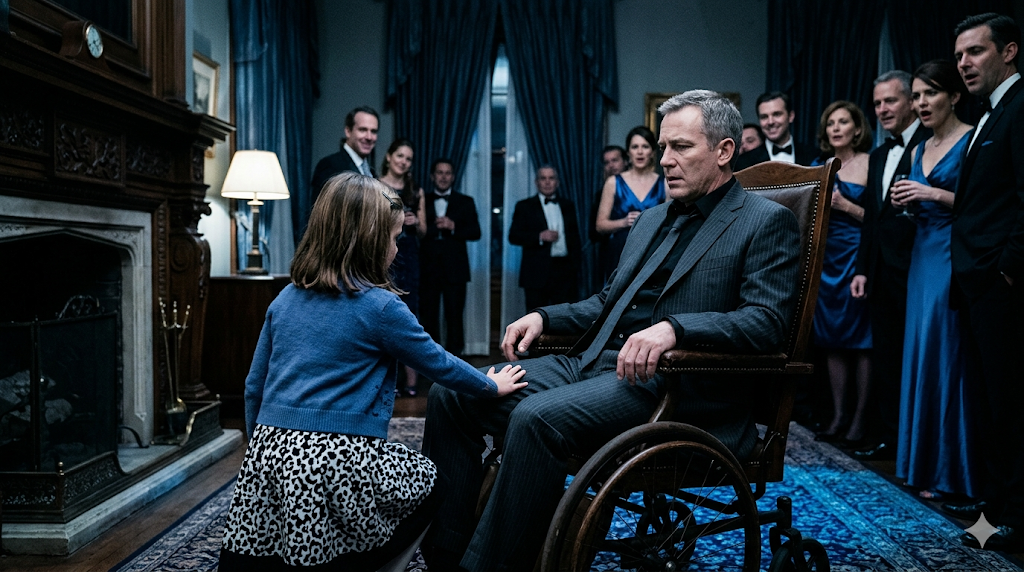
“One million dollars. Every last cent is yours… if you can make me walk again.”
Laughter detonated across the moonlit courtyard like a firework.
A man in a tailored Italian suit slapped the crystal table hard enough to rattle the champagne flutes. A socialite in a silk dress lifted her phone, already framing the shot, already composing the caption in her head. Around the long table, eighteen of the wealthiest people in the city grinned with that particular cruelty only the truly comfortable can afford — the kind that comes from never having needed anything in your entire life.
Beneath the warm amber glow of the Cole mansion’s garden lights, my daughter Lily stood completely still.
She was seven years old. She was wearing a yellow dress with a small white collar that I had ironed three times that morning because it was the only nice thing she owned. Her tiny bare feet pressed against the cold Italian marble, and I could see them trembling from where I stood.
I was Maria Reyes. I was thirty-four years old, a widow, and I had been scrubbing floors in this mansion for eleven months at ten dollars an hour, six days a week, fourteen hours a day. I did it so that Lily could eat. I did it so we wouldn’t sleep in the car again, the way we had for six weeks the previous winter, when she had pressed her small face against the frosted window and asked me if the stars were God’s nightlights.
I did it because there was nothing I wouldn’t do for her.
Ethan Cole sat in his custom black leather electric wheelchair at the head of the table. He was forty-one, brutally handsome in the way that powerful men sometimes are — a face built for trust, eyes built for manipulation. He had made his first billion at twenty-eight developing logistics software. He had made his second by acquiring and dismantling seventeen smaller companies. He was currently in the middle of a landmark civil lawsuit against Varro Automotive, claiming that their faulty brake system had caused the crash that left him permanently paralyzed from the waist down two years ago. The lawsuit was expected to settle for close to three billion dollars.
He was also, I had begun to suspect over these eleven months, a man with a secret that would destroy everything he had built.
But tonight, he wasn’t thinking about secrets.
Tonight, he was thinking about sport.
“Mr. Cole, please,” I whispered, stepping forward, gripping the mop handle until my knuckles went white. “We will leave immediately. Lily won’t bother your guests—”
The temperature in the courtyard seemed to drop ten degrees.
Ethan turned his head toward me with the slow, deliberate patience of a man who has never once been interrupted without consequence.
“Did I give you permission to speak?”
I stopped breathing.
Soft, appreciative laughter moved around the table. One of the women — I recognized her from the gossip columns, a city councilwoman — brought her napkin to her lips to hide her smile.
Lily turned and looked at me.
Her eyes were the color of dark honey, the same as her father’s had been. In those eyes I saw fear, yes. But underneath the fear — something steadier. Something older than seven years should carry.
I gave the smallest nod I could manage.
You can do this. Whatever this is — you can do this.
Lily turned back around.
She walked across the silent garden on her small bare feet, each step almost soundless on the marble, and she stopped directly in front of Ethan Cole’s wheelchair. She had to tilt her head back to look up at him.
Every phone at the table was now recording.
Ethan studied her the way a scientist studies something unexpected under a microscope — not warmly, but with genuine, clinical interest.
“Can you read?” he asked.
“Yes, sir.”
“Can you count to one hundred?”
“Yes, sir.”
Something shifted almost imperceptibly in his expression. He had expected tears by now. He had expected her to run back to me, or to stand there frozen and mute and humiliated while his guests laughed and the video spread across social media by morning.
He had not expected yes, sir.
“Then you understand,” he said slowly, “what one million dollars means.”
Lily was quiet for a moment. The garden was so silent I could hear the fountain at the far end of the courtyard and the distant sound of the city beyond the high stone walls.
Then she said, softly enough that the wind almost swallowed the words:
“It’s more money than my mother will ever see in her whole life.”
Three people at the table stopped smiling.
No one had written that line for her. No one had coached her. It came out the way true things do — plain and clean and impossible to argue with.
Ethan stared at her.
“Good,” he said finally. The word came out different than before — slower, something careful threading through it. “Then show me what you think you can do.”
Lily stepped closer.
Her hands were shaking. I could see them from across the garden, those small hands trembling at her sides. But her eyes — her eyes were completely still. Looking at Ethan Cole the way she sometimes looked at broken birds she found in the park, with that precise, quiet attention she gave to things that were hurt and hiding it.
She reached out.
She placed both of her small palms flat against Ethan’s legs, just above his knees, and she closed her eyes.
The laughter died instantly.
Not because anything supernatural happened. Not because Ethan Cole suddenly stood up from his chair.
Because of his face.
Because the most powerful man at the table — the man who had reduced me to silence with four words, whose guests recorded everything, who wielded his injury like a weapon worth three billion dollars — that man went the color of old chalk the moment my daughter’s hands touched his legs.
His jaw tightened.
His hands gripped the armrests of the wheelchair.
And in the frozen silence that followed, Lily opened her eyes and looked up at him.
She said nothing.
She didn’t need to.
Chapter 2: What a Child Knows
I found out later — much later — what Lily had actually noticed.
It began eight weeks earlier, on a Tuesday morning in October, when I was mopping the east corridor outside Ethan’s private study. Lily had a half-day at school and I had brought her to the mansion because our neighbor Mrs. Petrakis, who sometimes watched her, was at a doctor’s appointment. I had set Lily up in the supply room with her coloring books and strict instructions not to wander.
Lily, being Lily, wandered.
Not out of mischief. Out of curiosity — the irrepressible, gentle curiosity that had been her defining feature since she was old enough to point at things and ask why. She followed a cat. The estate had a grey tabby named Senator that prowled the grounds, and Senator had padded down the east corridor and slipped through a gap in a door that hadn’t latched properly, and Lily had followed him because she always followed cats.
The door was to Ethan Cole’s private gymnasium.
What she saw, she didn’t fully understand.
She saw the man in the wheelchair standing up.
Not struggling. Not hauling himself upright with the white-knuckled effort of someone defying their injury. Just — standing. Naturally. The way people stand when they forget to perform being still. He was at the far end of the room, his back to the door, speaking on the phone in a low, tense voice, and he was pacing.
Pacing.
Short, tight steps. The steps of a man who had been standing and walking and pacing his whole life and couldn’t stop the habit even when the habit was costing him everything.
Lily watched for forty-seven seconds — she counted, because she was working on counting, and forty-seven was a very good number — and then Senator meowed, and Ethan Cole spun around, and Lily was already gone, running silently back down the corridor on her small bare feet, Senator bounding ahead of her.
She hadn’t told me.
Not because she was afraid. But because she was seven and she had watched enough of my exhausted face across enough dinner tables to understand, in the wordless way children understand the things adults try to hide, that this information was fragile. That it needed to be handled carefully. That if she gave it to the wrong person at the wrong moment, it would shatter, and whatever it could become would be lost forever.
So she carried it.
She carried it for eight weeks, through parent-teacher conferences and school lunches and nights when I tucked her in and she looked at me with those honey-dark eyes and said nothing.
She was waiting.
And in the Cole mansion’s moonlit courtyard, with eighteen phones recording and eighteen people watching, with one million dollars on the table and my heart somewhere in my throat — she decided the moment had finally come.
She placed her hands on his legs.
She looked up at him.
And she said, in a voice so quiet only he could hear it:
“I saw you walking.”
Chapter 3: The Weight of a Secret
The party ended within twenty minutes.
Ethan Cole said he was tired, which was not a phrase his guests were accustomed to hearing, and the cars began appearing in the driveway with a haste that suggested everyone understood, without being told, that the evening was over. The councilwoman left first. The man who had slapped the table left without making eye contact with anyone.
I was told to wait.
Lily sat beside me on a stone bench near the fountain, leaning against my arm, and we listened to the last cars pull away until there was only the water and the night insects and the distant sound of the city.
One of the staff — a man named David who had always been kind to me — came to tell us that Mr. Cole wanted to see us in the study.
I had been in the study once before to clean it. Floor-to-ceiling bookshelves. A fireplace with a carved marble mantle. A desk the size of a small boat. The kind of room designed to remind you of your own smallness.
Ethan was behind the desk when we entered.
He wasn’t in the wheelchair.
He was standing.
He looked at Lily for a long moment. Then at me. Then back at Lily.
“How much did you see?” he asked her.
“You were walking and talking on the phone,” she said. “You didn’t know I was there.”
“No,” he said. “I didn’t.” He was quiet for a moment. “Do you know what that means? What I’m involved in?”
“A lawsuit,” she said. “For a lot of money.”
“Yes.”
“My mom says lawsuits are how people fight when they can’t fight any other way.”
Something passed across Ethan Cole’s face that I had never seen there before. Something that looked almost like pain that wasn’t performed.
“Your mother,” he said slowly, “is more insightful than I gave her credit for.”
He looked at me then. Really looked, in a way that felt different from the eleven months of looking through me.
“I had an accident,” he said. “A real one. I was paralyzed. For eight months.” He paused. “And then I wasn’t. The surgery worked. Experimental procedure — privately done, off the record.” Another pause. “The lawsuit was already filed. The settlement was already close. I had built everything around being the man in that chair.” He sat down — on the edge of the desk, not in the wheelchair — as though the performance had become too heavy. “And I didn’t know how to stop.”
The room was very quiet.
Lily looked at him the way she always looked at hurt things.
“Were you scared?” she asked.
Ethan Cole blinked.
Of all the questions in the world, he had clearly not expected that one.
“Yes,” he said, after a long time. “I was scared.”
“My mom gets scared too,” Lily said. “But she doesn’t pretend to be something she’s not. Because she says pretending costs more than it saves.”
I hadn’t realized I’d taught her that. I hadn’t realized I’d said it often enough for it to take root.
Ethan Cole looked at his hands.
Chapter 4: The Weight That Lifts
He could have threatened us. That possibility sat in the room like a fourth person, and I was aware of it every second.
He could have had his lawyers make our lives very small, very fast. We had nothing. No recordings, no evidence — only a seven-year-old child’s word against one of the wealthiest men in the city.
He didn’t.
What he did instead was sit with us for two hours in that firelit study while the night deepened outside, and he talked. Not the way powerful men usually talk — projecting, performing, filling space with the sound of their own authority. He talked quietly. He talked about the crash, which had been real and terrifying. About the eight months in the chair, which had been the most humbling experience of his life. About waking up one morning after the surgery to find that his legs worked, and feeling not only joy but a terror so complete it paralyzed him in a new way. Because the lawsuit was filed. Because the narrative was set. Because three billion dollars and his entire public identity had been built on a story that was no longer true.
“I kept thinking,” he said, “that I would find a moment to walk it back. To come forward.” He rubbed the back of his neck. “There was never a moment I could see clearly enough.”
“There’s one now,” Lily said.
He looked at her.
She looked back.
Seven years old, in a yellow dress with a white collar, sitting beside her exhausted mother in a room that could have swallowed their apartment three times over.
“There is,” he said. “Yes.”
Chapter 5: What Came After
Ethan Cole withdrew the lawsuit the following month.
The public statement cited “evolving medical circumstances” and “a decision to prioritize integrity over settlement.” His legal team was furious. Several board members resigned. The story ran in every major paper and dominated financial news for two weeks — the billionaire who walked away from three billion dollars, and from his wheelchair.
He did not name us.
He did not have to.
What he did: he established a fund — quietly, through an intermediary, structured as an educational trust — that covered Lily’s schooling through college, and provided me with a stable income for the first time in my adult life. Not charity, the letter said. Restitution.
For what you were owed the night I used your daughter as entertainment. And for what she gave me in return, which was worth considerably more than one million dollars.
I read that letter sitting on the floor of our small apartment, Lily asleep in the next room, and I cried the way you cry when something that has been tightly wound for a very long time finally, finally releases.
The night of the party, walking home across the city with Lily’s hand in mine because we couldn’t afford a cab, she had asked me one question.
“Mom, was I right to tell him?”
I thought about Ethan Cole’s face in the moment after her hands touched his legs. The chalk-white stillness of a man watching his most carefully guarded secret walk toward him in the form of a seven-year-old girl.
I thought about the two hours in the study. About the word restitution.
“You were right,” I told her.
She nodded, satisfied, and we walked the rest of the way in comfortable silence, our shadows stretching long under the streetlights.
She had seen something no one else had seen — not because she was extraordinary, though she was — but because she was paying attention in a way that adults, worn down by their own performances and exhaustions, had stopped doing.
She had looked.
And what she found there had been enough to change everything.